
Direct Answer
Start with Netflix alone if you are still proving the habit. Many learners quietly fail here not because the show is wrong, but because the routine gets stuck at the same point every night. Use Language Reactor or another subtitle helper if meaning is the bottleneck. Use FunFluen when speaking is the bottleneck and you need to turn one scene into active recall, shadowing, and a line you can say without staring at subtitles.
That is the real Language Learning with Netflix free vs Pro decision. Free is enough for watching, pausing, and writing a few phrases. Pro becomes useful when your routine breaks at the same point every time: you cannot catch the meaning, cannot save the phrase, or cannot speak the phrase later.
Last checked: May 22, 2026. Prices, free tiers, browser support, and plan limits can change, so treat this as a decision guide, not a live pricing page.
Free vs Pro comparison
Use this pricing-neutral Free vs Pro comparison before choosing a tool:
| Need | Free Netflix alone | Language Reactor-style free/pro support | FunFluen-style pro support |
|---|---|---|---|
| Watch with available audio/subtitles | Yes | Uses Netflix playback plus extra subtitle tooling | Used after or alongside the scene |
| Dual subtitles | Usually no | Often a core reason to try it; check current plan limits | Not the main job |
| Popup meaning or dictionary help | Manual lookup | Often a core feature; verify current browser support | Secondary |
| Playback shortcuts and line replay | Native controls only | Often stronger on desktop | Useful only if tied to practice |
| Save phrases for review | Manual tracker | Depends on current tier and setup | Core value when review/speaking is the gap |
| Speaking or shadowing workflow | Manual option | Limited compared with dedicated speaking practice | Core value |
| Best reason to pay now | None if the habit is unproven | Pay if lookup, dual subtitles, or replay saves real time | Pay if speaking, shadowing, or review is where your routine breaks |
Stay free if you only watch casually, do not review phrases, or have not formed the habit. Pay only if a specific feature saves time in a routine you already repeat. Do not pay if you are hoping a tool will create the habit for you.
Best Default Choice
The best default choice is a two-week free test before paying. Use Netflix alone for one short scene a day. If you can capture one useful phrase and review it tomorrow, stay free. If the same step keeps breaking, choose the tool that fixes that step.
| Your real problem | Best default choice | Why |
|---|---|---|
| You do not watch consistently | Netflix alone | A paid tool will not fix an absent habit. |
| You understand little without translation | Language Reactor-style subtitle help | Meaning is the bottleneck. |
| You understand scenes but cannot say anything | FunFluen-style speaking practice | Speaking is the bottleneck. |
| You save words but never review them | A tracker or Pro workflow | The gap is review, not subtitles. |
| You rewind constantly | Subtitle/replay controls | The friction is mechanical. |
| You want one phrase to become usable speech | FunFluen speaking loop | You need output pressure after watching. |
Language Learning with Netflix free is good for discovery. A Pro workflow is worth testing only when it removes friction from a practice loop you already want to repeat.
Meaning-vs-Speaking Decision
Ask one question before choosing anything: is meaning the bottleneck, or is speaking the bottleneck?
| Signal | Meaning is the bottleneck | Speaking is the bottleneck |
|---|---|---|
| What happens during the scene | You miss the basic point | You understand but stay silent |
| Best support | Bilingual or target-language subtitle help | Pause, guess, reveal, shadow, speak |
| Typical tool fit | Language Reactor | FunFluen |
| Free workaround | Native subtitles plus a small notebook | Say one learner-made line aloud |
| Upgrade reason | Faster lookup and subtitle comparison | More pressure to produce language |
If meaning is the bottleneck, do not jump straight into speaking drills. First make the scene understandable. If speaking is the bottleneck, more subtitle reading may feel productive while leaving the actual problem untouched.
Current Feature Check
Feature names and availability change, so check your exact browser, device, Netflix title, current plan limits, and language tracks before paying. Use this Current Feature Check:
| Feature you need | Free Netflix alone | Language Reactor-style tool | FunFluen-style workflow |
|---|---|---|---|
| Watch the show | Yes | Yes | Alongside your watching |
| Native subtitles | Often, depending on title | Uses available tracks | Uses your selected phrase or practice line |
| Dual subtitles | Usually no | Often the core value | Not the main job |
| Quick meaning support | Limited | Stronger | Secondary |
| Save a practice phrase | Manual option | Sometimes | Core workflow |
| Speaking pressure | Manual option | Limited | Core workflow |
| Review tomorrow | Manual tracker | Depends on setup | Designed around practice |
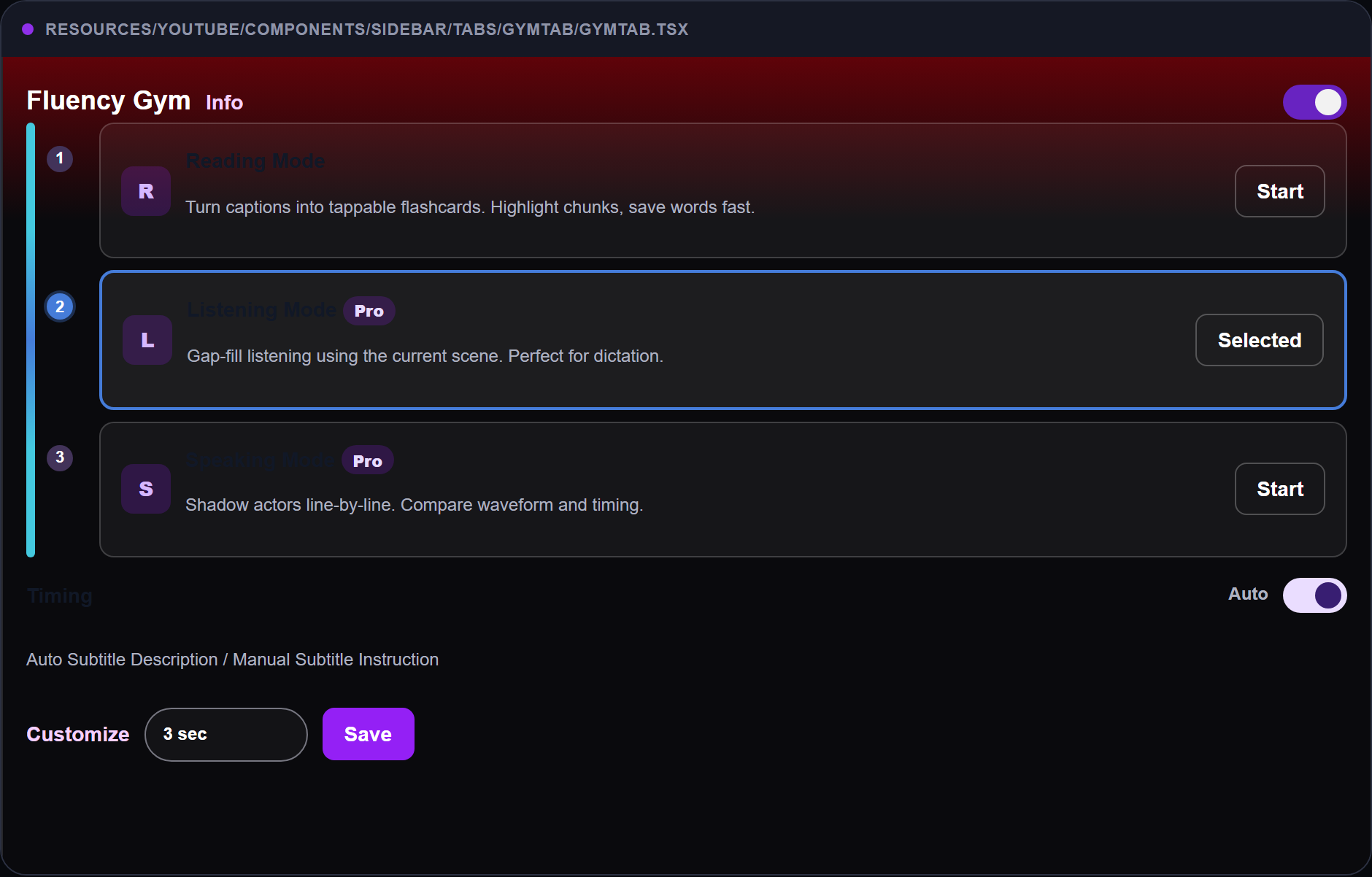
Use this screenshot as a visual example of the speaking-practice workflow you are evaluating: not a magic fluency switch, but a place where a saved line can become a speaking task.
Bottleneck Test
Run this Bottleneck Test before you install or pay for anything.
- Pick a three-minute scene from a show you actually want to watch.
- Watch once with your normal subtitles.
- Pause after one short line or phrase.
- Guess what it means without copying long dialogue.
- Reveal the support you need: translation, target-language subtitle, or your own note.
- Shadow the rhythm once.
- Speak one learner-made sentence using the same pattern.
- Save only that one phrase for tomorrow.
If step 4 fails, meaning is the bottleneck. If step 7 fails, speaking is the bottleneck. If step 8 fails, review organization is the bottleneck.
Which tool is better
Neither tool is universally better. Language Reactor is better when you need help understanding and comparing subtitles. FunFluen is better when you already have a useful phrase and need to practice saying it.
| Decision | Choose Language Reactor-style help | Choose FunFluen-style help |
|---|---|---|
| Main job | Understand the scene | Use the scene |
| Best learner stage | Beginner to intermediate meaning support | Intermediate speaking and retention |
| Strongest moment | While subtitles are on screen | After you choose a line |
| Weakest moment | Turning recognition into speech | Explaining every subtitle meaning |
| Free alternative | Pause, replay, notebook | Pause, guess, speak, tracker |
| Paid justification | Less subtitle friction | More output practice |
The free option can still beat both if you are not ready to repeat scenes. A clean manual option is: Netflix alone, one phrase, one learner-made sentence, one review tomorrow.
Is FunFluen a Language Reactor Alternative?
FunFluen is a Language Reactor alternative only if your reason for using Language Reactor is practice after the scene. It is not the same kind of tool if your main need is dual subtitles, dictionary lookup, or line-by-line meaning while watching.
Think of the split this way:
| Question | Better fit |
|---|---|
| "What did that line mean?" | Language Reactor |
| "How do I say something like that?" | FunFluen |
| "Can I compare two subtitle tracks?" | Language Reactor |
| "Can I turn this into speaking practice?" | FunFluen |
| "Can I watch free and write notes myself?" | Netflix alone |
That is why a Language Reactor alternative search can be misleading. The better comparison is not brand versus brand. It is meaning support versus speaking support.
Who Should Not Choose FunFluen First?
Do not choose FunFluen first if the scene is still confusing even with subtitles. First make Netflix itself usable. Choose a clearer show, a shorter scene, or a language track that is available in your region.
You should not choose FunFluen first if:
- You have not tried Netflix alone for at least a few sessions.
- You want dual subtitles more than speaking practice.
- You are not willing to repeat one short line.
- You expect any tool to create fluency by itself.
- You need unavailable Netflix audio or subtitles to appear.
FunFluen works best after the scene is understandable enough that one line deserves practice.
FunFluen speaking loop
The FunFluen speaking loop is simple: scene, pause, guess, reveal, shadow, speak, save.
| Loop step | What you do | Why it matters |
|---|---|---|
| Scene | Watch a short moment | Context makes the phrase memorable. |
| Pause | Stop before you drift | Attention becomes deliberate. |
| Guess | Try meaning or response first | Recall beats rereading. |
| Reveal | Check the support | You correct the guess. |
| Shadow | Copy rhythm briefly | Sound becomes physical. |
| Speak | Say your own version | Recognition becomes output. |
| Save | Keep one line for tomorrow | Practice survives the episode. |
Netflix gives you the scene. FunFluen gives you a more repeatable way to push a line toward speech. That is a before/after distinction: before, you notice a phrase and keep watching; after, you turn the phrase into a short speaking task.
Test Both in One Scene
Use this Test Both in One Scene method for five minutes.
- Open a three-minute scene.
- Watch it once with Netflix alone.
- If you cannot follow the meaning, test Language Reactor-style subtitle support.
- If you can follow the meaning, pause on one line.
- Guess the line's meaning or likely response.
- Reveal your support.
- Shadow once.
- Speak one learner-made sentence.
- Save the line.
Decision: if subtitle comparison changed everything, use Language Reactor-style help. If speaking the line exposed the real gap, install FunFluen and practice one line with pause, guess, reveal, shadow, and speak for five minutes.
Free vs Pro scorecard
Score each line from 0 to 2.
| Question | 0 | 1 | 2 |
|---|---|---|---|
| I watch scenes at least twice a week | No | Sometimes | Yes |
| I know whether meaning or speaking is the bottleneck | No | Maybe | Yes |
| I review phrases tomorrow | No | Sometimes | Yes |
| I can name the feature I need | No | Vaguely | Exactly |
| I use a desktop browser when practicing | No | Sometimes | Yes |
0-4: stay free and fix the habit.
5-7: test one Pro feature for one week.
8-10: a Pro workflow is reasonable because you already have a repeatable scene-learning loop.
Device and availability notes
Netflix audio, subtitles, and catalogs vary by region, device, profile, plan, and title. Browser tools may work on desktop but not on TV apps or mobile apps. Subtitle helper features can also change when Netflix changes its interface.
Before paying, test the exact show, language, device, and browser you plan to use. The right tool on the wrong setup is still the wrong purchase.
Best practical setup
Use this order:
- Start with Netflix alone.
- Add a one-scene tracker.
- If meaning fails, test Language Reactor-style subtitle help.
- If speaking fails, test FunFluen.
- Keep only the tool that makes tomorrow's review easier.
For related workflows, start with the broader Language Learning with Netflix hub. If you want scene vocabulary specifically, use Learn Korean or English with Squid Game. If subtitles are the issue, compare how to get dual subtitles on Netflix. When one line is ready for output practice, use practice on FunFluen.
FAQ
Is Language Learning with Netflix free enough?
Yes, if you can watch one short scene, capture one phrase, and review it tomorrow. Language Learning with Netflix free is enough until the routine breaks at a specific point.
Is Pro worth it for beginners?
Usually not at first. Beginners should make scenes understandable before adding more tools. If meaning is the bottleneck, subtitle help may be useful; if the whole show is too hard, choose an easier scene.
Is Language Reactor vs FunFluen the right comparison?
It is useful only if you compare the jobs. Language Reactor is mainly meaning support. FunFluen is mainly speaking and review support. The better question is whether meaning or speaking is blocking you. FunFluen vs Language Reactor becomes useful only after you define the job first.
Can I use both?
Yes. You might use Language Reactor-style help to understand a line, then use FunFluen to practice saying a response. But do not add both before proving that one scene a day is realistic.
Does FunFluen replace Netflix?
No. Netflix supplies the scene. FunFluen helps after you choose a phrase you want to practice. It does not add missing Netflix tracks, replace regional availability, or create fluency by itself.
What should I do today?
Choose one Netflix scene, test one line, and decide whether meaning or speaking is the bottleneck. If speaking is the bottleneck, install FunFluen, practice one line with pause, guess, reveal, shadow, and speak, and keep the test to five minutes.