How to Learn English with Netflix
Get a clear guide to How to Learn English with Netflix. Learn the key points, avoid confusion, and make it practical for learners.

Why Netflix Feels Productive but Still Leaves You Stuck Speaking
You can watch three episodes in English and feel smart the whole time, then freeze when you need one simple sentence in real life. You followed the story, caught a few new words, maybe even laughed at a joke, but when real conversation arrives, the line does not come out.
The cruel part of Netflix learning is that it can make you feel fluent while quietly training you to stay silent. That gap is not a character flaw. It is the gap between recognizing English and producing English. This guide teaches the manual Netflix-only loop first; FunFluen comes in as the easier way to repeat the same practice, not the only path.
The same manual scene loop and FunFluen acceleration can work for other target languages when suitable audio and subtitles are available. The examples here focus on English because that is the search need.
The Short Answer
Yes, Netflix can help you learn English, but not by watching full episodes passively. It helps when you turn one short scene into active practice.
The useful loop is simple: understand the scene, replay it, hide some support, guess a useful line, shadow the actor, save a few phrases, and come back tomorrow. That is how Netflix starts moving from "I understand this" toward "I can say something like this."
Your First 3-Minute Practice Session
Try this before you read the full plan:
- Pick a 30-60 second scene with ordinary conversation.
- Watch once for meaning.
- Replay with English subtitles.
- Pause before one useful line and guess what the person will say.
- Play the line and shadow it once or twice.
- Write down one phrase you could actually use this week.
That is enough for a first win. The rest of the article, including the weekly plan below, helps you repeat that loop without turning Netflix practice into homework you secretly avoid.
Approach 1: The Netflix-Only Practice Loop
Start with original audio and subtitles, but do not treat subtitles as the lesson. Treat them as temporary support. The goal is to make your ear and mouth do more of the work over time.
Pick one short scene. Watch it once for meaning, then replay it with English subtitles. On the next pass, hide the subtitles for a few seconds at a time or look away during an important line. Pause before a phrase you might use in real life. Guess it. Then play the line, listen to the rhythm, and shadow the actor.
At first, this can feel awkward. You may repeat one sentence five times and still sound slower than the actor. That is normal. A real sign of progress is smaller: you hear the line again and your mouth is already ready for part of it. Another sign is that you catch a contraction or weak word before reading it.
Example: One Scene, Seven Practice Moves
Use this invented practice example, not a real show quote:
I thought we were leaving at six.
With Netflix alone, you can practice it like this:
- Watch the scene once so you understand the situation.
- Replay and notice how the line sounds faster than it looks.
- Hide the subtitle for the final pass.
- Pause before the reply and guess as much as you can.
- Reveal the line, check what you missed, and read it aloud.
- Listen again and shadow the actor, especially the rhythm of "thought we were."
- Save one phrase, "I thought we were...," and reuse it in your own sentence.
The manual friction is real: repeated pausing, subtitle switching, saving phrases by hand, losing focus while you manage the player, and forgetting to review tomorrow. That work is useful, but it is also why many learners stop after two days.
Try One Line Now
Before you continue, choose one line from a scene you watched recently and say it out loud three times. First slowly. Then with the actor. Then once without looking. If the third version is rough but recognizable, the practice is working.
Best Setup by Level
The same scene can be useful at different levels if you change the amount of support.
B1
Choose clear sitcom, family, or teen scenes with everyday emotion and short turns. Use native-language support first if you need it, then replay with English subtitles. Do not begin with fast crime scenes or workplace arguments.
B2
Start with English subtitles, then hide them for short stretches. Your main job is to notice missing little words: contractions, weak forms, and fast links between words.
Strong B2/C1
Watch the scene once without subtitles, then replay with English subtitles to check what you missed. At this level, the best practice is not "understand the plot." It is catching tone, speed, implication, and the exact way a sentence is built.
What Kinds of Shows Work Best?
Use real shows as broad category examples, not as exact scene promises.
- Sitcoms such as Friends or The Good Place can help with everyday phrases, reactions, and casual rhythm.
- Teen or family shows such as Stranger Things can be useful for clear emotion, disagreement, and short direct lines.
- Workplace or legal dramas such as Suits can expose you to more formal pressure, persuasion, and confident phrasing.
- Crime and thriller shows can train faster listening, but they are usually better after you already have a stable routine.
The best show is not always the most famous show. It is the show where you can repeat one scene without getting exhausted.
Why One Short Scene Beats One Full Episode
One full episode gives you a lot of input, but it often lets you stay passive. One short scene gives you enough room to repeat, test yourself, and speak.
This is similar to active recall and output practice in plain language. Input helps you recognize English, but output practice asks you to produce it before the answer is safely in front of you. That is the gap many input-only routines leave open: you understand the sentence, but you have not yet practiced making it come out of your own mouth.
With one scene, you can:
- Hear the same sentence several times without losing the story.
- Guess before the subtitle gives you the answer.
- Shadow the actor until the rhythm feels less foreign.
- Save a few useful phrases instead of collecting a long list you never review.
- Notice progress because the same line becomes easier across repeated passes.
That is why "one scene done deeply" beats "one episode watched vaguely."
7-Day Netflix-Only Study Plan
Use one short scene for the whole week. That may sound repetitive, but repetition is the point. You are teaching your brain that the scene is not just entertainment. It is speaking material.
Day 1: Understand the Scene
Watch once for meaning. Write one sentence about what is happening. Do not memorize yet.
Day 2: Catch the Fast Words
Replay with English subtitles and mark two places where the spoken audio sounds shorter than the written subtitle.
Day 3: Guess the Next Line
Pause before three useful lines. Guess what comes next, then play and compare.
Day 4: Shadow One Sentence
Choose one sentence and shadow it five times. Focus on rhythm, not perfection.
Day 5: Save and Reuse Phrases
Save three phrases by hand. Write one new sentence with each phrase.
Day 6: Speak the Scene From Memory
Retell the scene in your own words. Short, imperfect English is fine.
Day 7: Test Yourself Without Subtitles
Watch the scene without subtitles. Notice what feels easier than Day 1, especially the phrases you practiced out loud.
Approach 2: Do the Same Loop With FunFluen
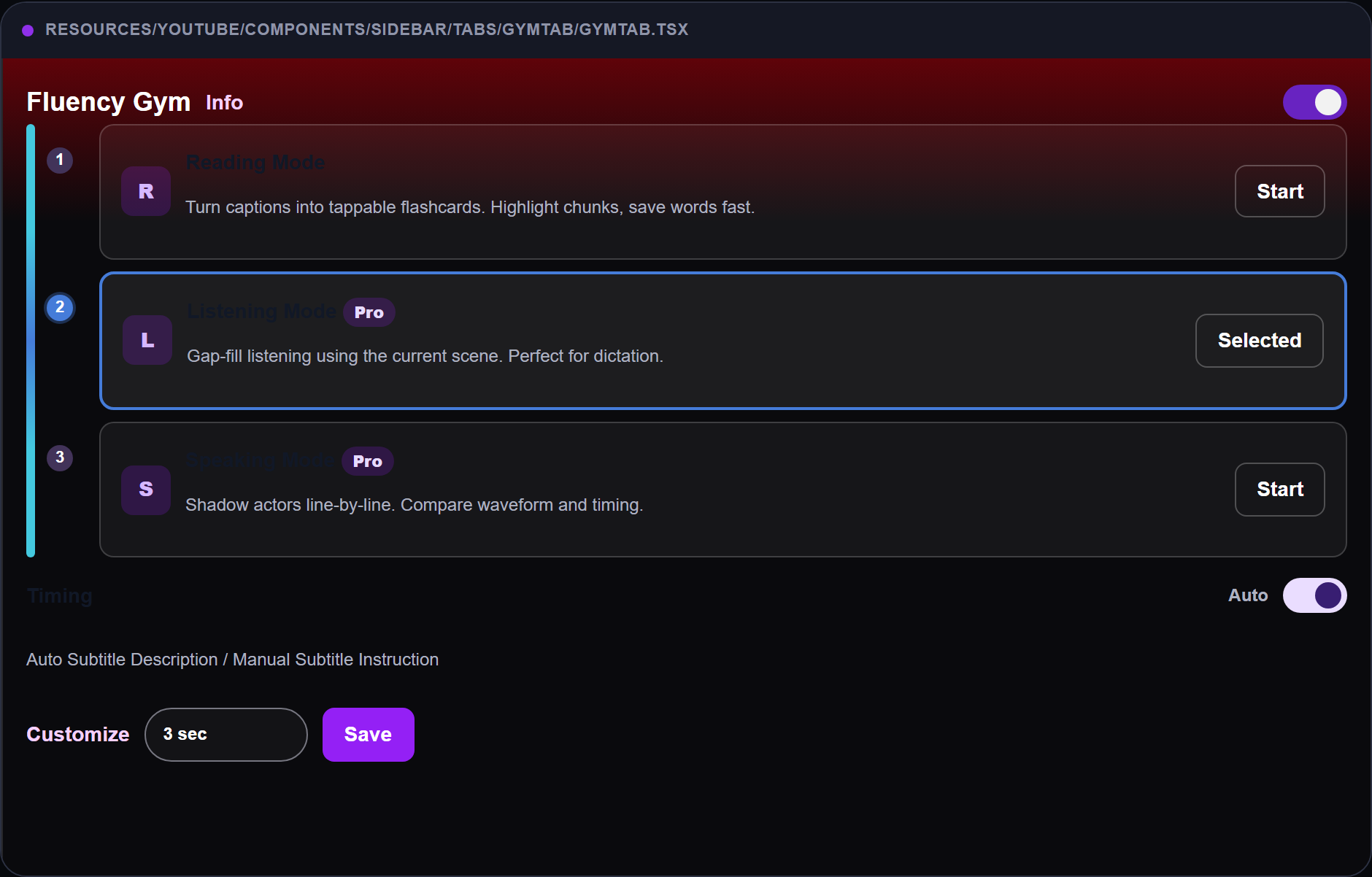
Understand faster
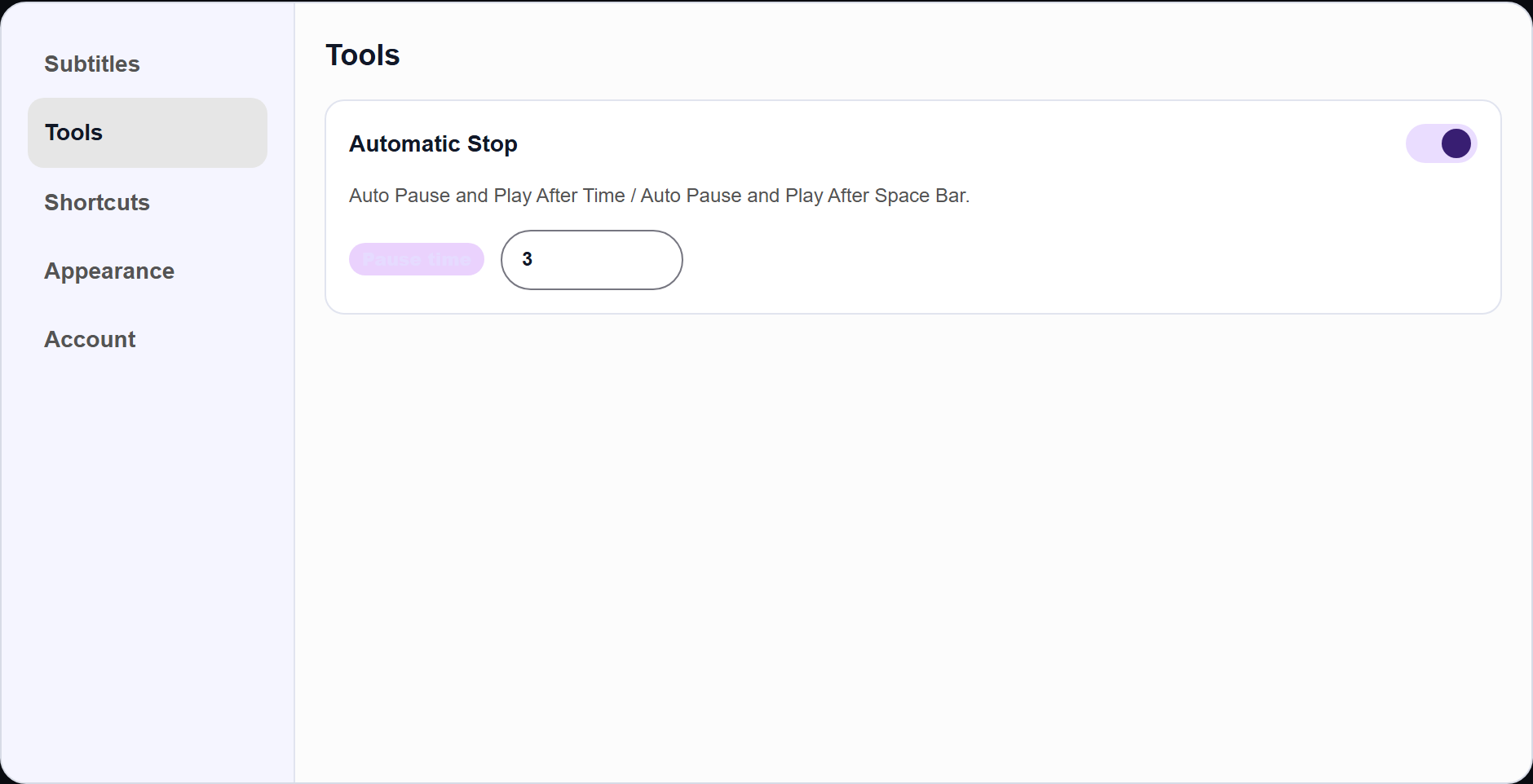
Dual subtitles keep meaning support close, so you spend less energy switching tracks and looking up every line.
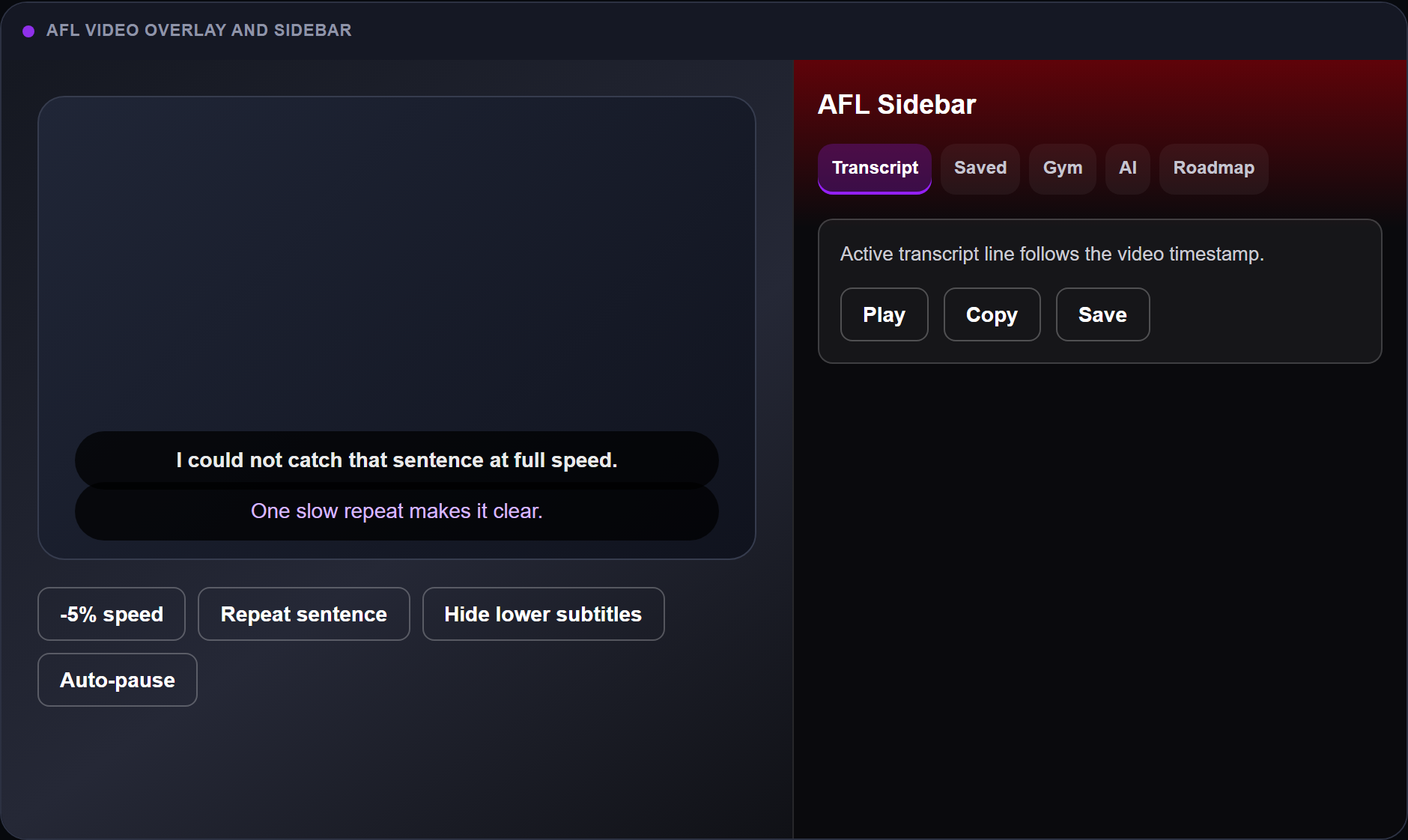
Practice line by line
Auto-pause turns the scene into subtitle-sized practice, so repeated pausing stops interrupting your focus.
Speak before real life
Listening and Speaking modes help you hear first, shadow out loud, and repeat the line with less setup.
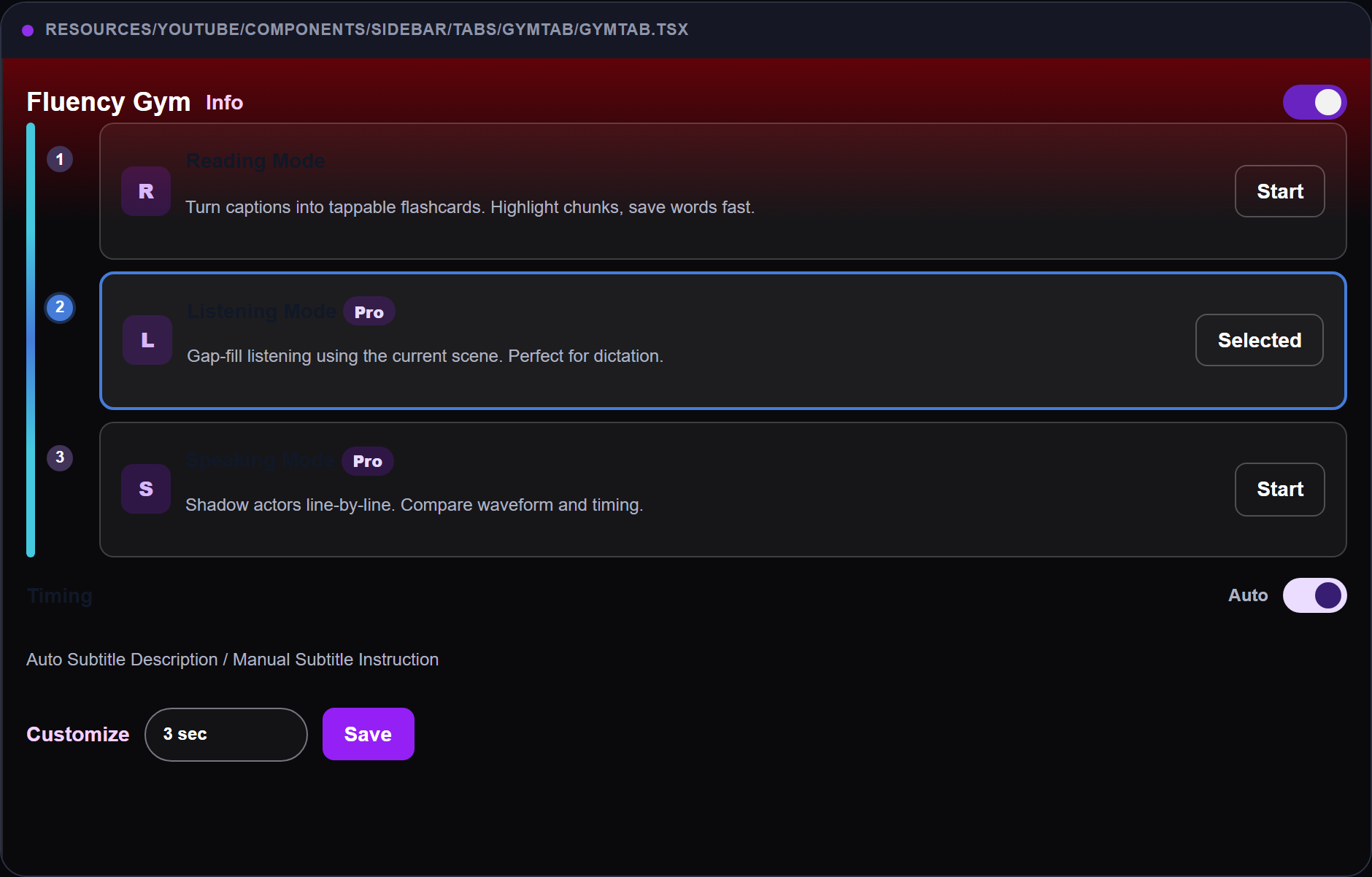
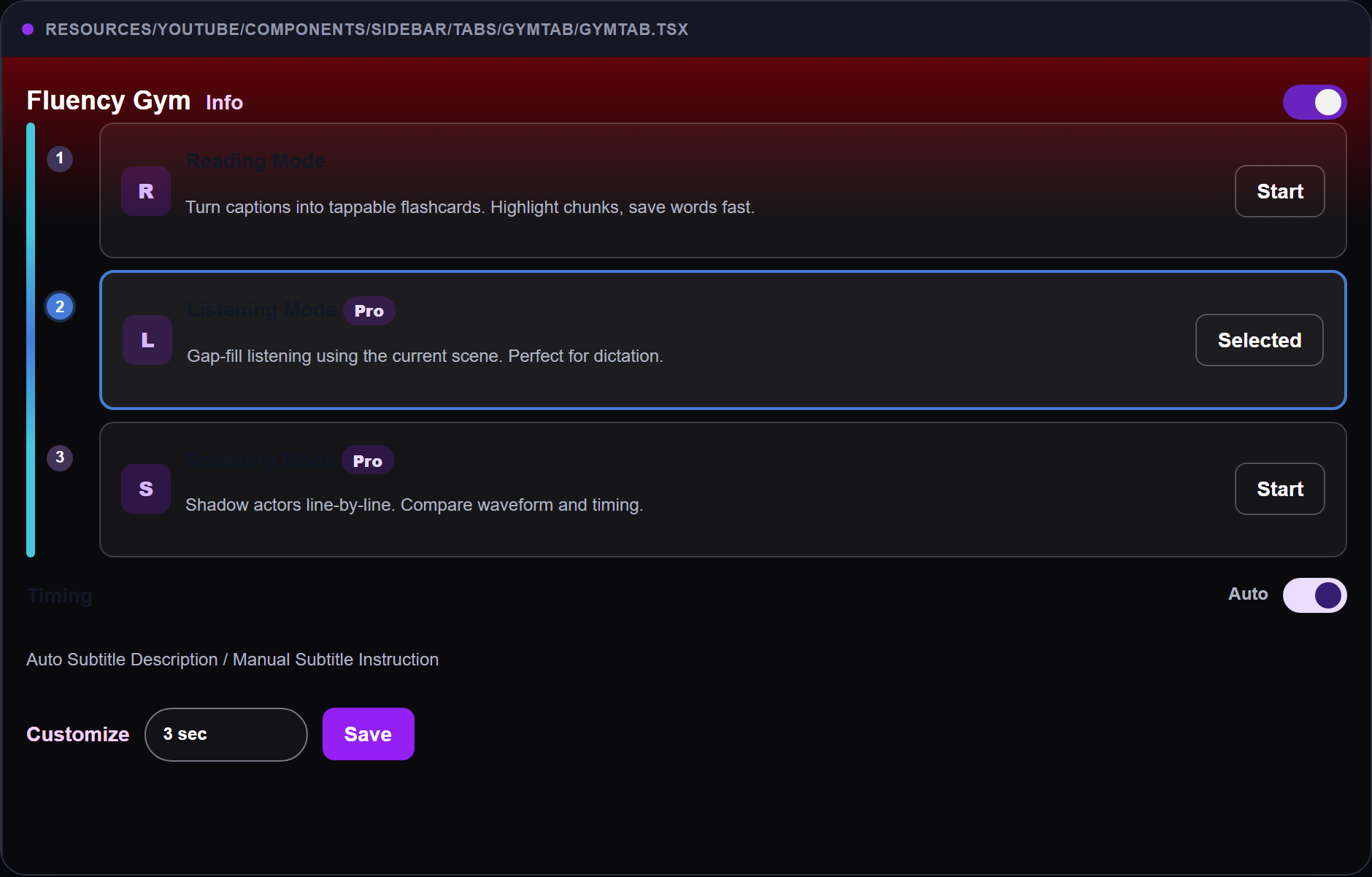
FunFluen should not replace the method. It should make the method less tiring.
Without FunFluen, you are the teacher, the remote control, the subtitle manager, the notebook, and the review system. That is why a good routine often disappears after two days. The learner was not lazy; the workflow was heavy.
With FunFluen, the scene becomes the exercise. The manual loop still matters, but the boring parts stop stealing so much attention:
- Dual subtitles reduce dictionary and subtitle switching.
- Auto-pause reduces the need to catch every stopping point manually.
- Fluency Gym turns guessing into a structured exercise instead of a random pause.
- Speaking mode makes shadowing and output practice easier to repeat.
- Saved phrase review makes tomorrow's practice harder to forget.
The important point is that FunFluen is not the only valid way to learn with Netflix. It is the smoother version of the same active practice loop.
How FunFluen Removes Friction From the Same 7 Methods
Keep the 7 methods. FunFluen should only make them less annoying to repeat:
- Understand the scene without subtitle switching. Dual subtitles keep meaning support close so you spend less energy jumping between tracks or dictionaries.
- Slow the fast line without fighting the player. Auto-pause or sentence replay turns one subtitle cue into the practice unit instead of making you hunt for the line.
- Guess before reveal with structure. Fluency Gym gives the guess-and-check moment a clear shape instead of leaving you to invent a quiz on the spot.
- Read until it feels sayable. Reading practice gives the line one focused rehearsal pass before full speaking practice.
- Listen before your eyes rescue you. Listening Mode keeps attention on the sound first, then lets text become feedback.
- Shadow the actor with less reset work. Speaking Mode helps you repeat the line out loud without losing the exact moment you are practicing.
- Save and review one useful phrase. Saved phrases keep tomorrow's review attached to the scene instead of disappearing in a notebook.
This is the conversion path that makes sense: start manually today, then use FunFluen when you want the same practice without fighting the player.
Netflix Alone vs Basic Subtitle Tools vs FunFluen
Netflix alone is enough to begin. It gives you the show, audio, and subtitles, but you manage the practice yourself.
Basic subtitle tools can help with lookup and dual-language support. They reduce some confusion, but they usually do not turn the scene into a complete speaking and review loop.
FunFluen is best when you want the full loop in one place: subtitle support, pausing, guessing, shadowing, speaking practice, and phrase review. It is not magic. It simply removes the small points of resistance that make good practice hard to repeat.
| Practice step | Netflix alone | Basic subtitle tools | With FunFluen |
|---|---|---|---|
| Understand the line | Switch subtitles or look words up manually | Add lookup or subtitle support, but still mostly read | Dual subtitles keep meaning support close |
| Pause at the right moment | Use the remote again and again | Usually still pause manually | Auto-pause turns lines into practice units |
| Guess the line | Invent a self-test on the spot | Usually no structured recall step | Fluency Gym gives the guess-and-check structure |
| Practice listening | Replay manually until you notice more | Compare subtitles, but the listening pass is still self-managed | Listening Mode keeps the focus on hearing first |
| Practice speaking | Shadow by yourself and hope you repeat enough | Usually no speaking workflow | Speaking Mode makes output practice easier to repeat |
| Review phrases | Use a notebook or separate app | Maybe save or copy lines, but review still lives elsewhere | Saved phrases make tomorrow's review easier |
Related guide: If your subtitles and audio do not match, read Why Netflix subtitles do not match the audio.
Common Mistakes
- Watching a full episode and calling it study.
- Choosing scenes that are too fast for your level.
- Reading subtitles instead of listening.
- Never speaking out loud.
- Saving too many phrases and reviewing none of them.
- Changing shows before one scene has become easier.
FAQ
Can I learn English with Netflix without an extension?
Yes. Use the Netflix-only loop: one short scene, repeated listening, subtitle reduction, guessing, shadowing, phrase saving, and review.
Should I use English subtitles or my native-language subtitles?
Use the support your level needs. B1 learners may need native-language support first. B2 learners should move toward English subtitles. Strong B2/C1 learners can try no subtitles first, then check with English subtitles.
What is shadowing?
Shadowing means speaking with or immediately after the actor, copying the rhythm and stress of the line. It is useful because it pushes the sentence out of recognition and into production.
Is Netflix enough to become fluent?
No, not by passive watching alone. Netflix can give you useful input, but fluency also needs output: speaking, recall, correction, review, and real conversation. A good Netflix routine should move you from "I understand that" toward "I can say something like that myself."
How long should I practice each day?
Ten focused minutes is better than a distracted full episode. A small routine you repeat is more valuable than an ambitious plan you abandon.
Should I practice with one show or many shows?
Start with one show and one scene. Once the loop feels natural, you can rotate shows by purpose: sitcoms for daily speech, workplace dramas for formal phrasing, and thrillers for faster listening.
Start With One Scene Today
Choose one short scene today and run the manual loop once. Understand it. Replay it. Guess one line. Shadow it. Save one phrase. Review it tomorrow.
If that loop feels useful but too easy to abandon, let FunFluen carry the boring parts. Install FunFluen, open one short Netflix scene, and try the same loop with less friction.
Your job is not to manage the player. Your job is to say the line before real life asks for it.