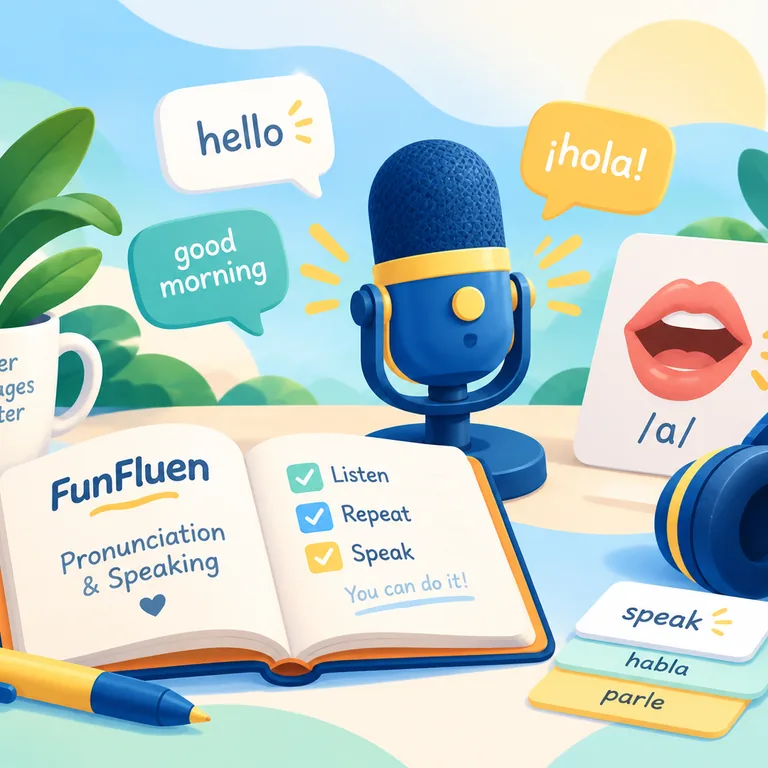
How to Use Slow-Motion Video to Study Mouth Position
Use slow-motion video to study visible mouth movement, avoid misleading frozen shapes, and know when to return to normal-speed pronunciation.
Guide directory
A complete A–Z path to every public guide, including older articles that no longer appear in Latest.
1940 guides · page 24 of 49
Use slow-motion video to study visible mouth movement, avoid misleading frozen shapes, and know when to return to normal-speed pronunciation.
Use Spotify video podcasts, audio, transcripts, and one spoken-response routine to improve listening and speaking without becoming dependent on text.
Use YouGlish better: check context, compare English region filters and real-speech clips, then turn one useful example into speaking practice.
Turn your English textbook audio into shadowing practice: understand the track, mark one line, echo it, shadow it, then make the language your own.
Use YouTube Expressive Speech dubs for listening and prosody without turning generated audio into your only accent model. Try the Accent Anchor method.
Learn how to use YouTube transcripts for language learning with captions, replay, phrase mining, shadowing, and a 20-minute active routine.
Verify a newsworthy person’s name fast: check identity, source freshness, confidence, and what to say when pronunciation evidence is incomplete.
Hulu captions still showing after you select Off? Find whether Hulu, your device, TV accessibility settings, or the video owns the text—and fix it in order.
The short answer is: sometimes the extension matters less than the workflow. Many learners search for a Hulu dual subtitles extension because they want...
Missing a subtitle language on Hulu? First prove whether the track exists, then use the right fix for title availability, app, or device problems.
Change Hulu subtitle size, font, color and background by device, with verified iPhone, Android, Apple TV and Roku paths plus fixes when styles do not apply.
Hulu subtitles don’t match the audio? Use one short scene to tell timing, wording and wrong-track problems apart—and apply the fix that fits.
Hulu playing the wrong audio language? Check the exact title version, available audio, and device to get back to the intended original track.
Hulu playing the wrong audio? Check the exact title version, restore the original track, and isolate device problems without chasing fake global settings.
Get a clear guide to Friends S1E7 Humor and Sarcasm: English Tone Lesson. Learn the key points, avoid confusion, and make it practical for learners.
Strong at reading but lost when English is spoken? Learn why print knowledge does not automatically become fast listening, then use a decoding-first plan.
Hear every English word but still miss the sentence? Learn to stop listening word by word, group speech into meaning units, and train the skill with a transcript.
Track who I, you, he, she and they refer to in Severance with a Referent Ledger, identity-frame resets, pronoun drills, and repair questions.
Decode Breaking Bad idioms and metaphors line by line: literal image, hidden meaning, power subtext, learner traps, and safer everyday English.
Decode Peaky Blinders idioms and British slang about power, money, loyalty, threats, and safe modern usage—without talking like a Shelby by accident.
Decode everyday Grey’s Anatomy idioms about recovery, decisions, teamwork, conflict, and emotional survival—with safe real-life examples and practice.
Learn 40 Stranger Things expressions line by line, with plain meanings, scene functions, register notes, examples, and active listening practice.
See how IELTS Listening raw marks relate to band scores, what IELTS officially publishes, why exact cutoffs can vary, and how to set a practical target.
Stop losing IELTS Listening Part 1 marks to spelling, numbers, dates, addresses, corrections and word limits with a practical accuracy routine.
Follow IELTS Listening Part 2 without losing your place: maps, orientation language, matching, multiple choice, timing, and a practical routine.
Learn IELTS Listening Part 3 with a speaker-position method for tracking opinions, corrections, matching questions, long options, timing, and practice.
Stay with IELTS Listening Part 4: follow lecture signposts, handle note and sentence completion, recover after a missed answer, and practise effectively.
Learn the six IELTS Listening question types, what each tests, and how to handle correction, rejection, qualification and paraphrase distractors.
Protect correctly heard IELTS Listening answers with clear rules for spelling, word limits, grammar fit, computer entry, and paper transfer where offered.
Understand IELTS Speaking band descriptors across fluency, vocabulary, grammar and pronunciation, then turn the four criteria into focused practice.
Learn how to answer IELTS Speaking Part 1 questions naturally with concise development, follow-up strategies, recovery moves, and a 10-minute practice loop.
Use your IELTS Speaking Part 2 minute wisely: choose an example, build short ordered notes, add details, and launch without scripting your answer.
Learn how to extend IELTS Speaking Part 3 answers with one clear reason, useful development and a confident stopping rule—without memorised scripts or rambling.
Immersive Translate bilingual subtitles missing on YouTube? Enable the documented bilingual mode, refresh once, then check the video subtitle source/settings.
Improve speaking fluency without a partner using recording, self-talk, shadowing, retelling, voice notes, AI prompts, and timed solo repeats.
Learn to hear the real job behind English questions—requests, repair, teasing or challenge—using practical Big Bang Theory examples and drills.
Learn how indirect resistance works in English through The Handmaid’s Tale: decode polite refusals, rhetorical pushback, deflection, and safer replies.
Learn to spot indirect threats and warnings in House of the Dragon, read the consequence behind polite wording, and respond calmly without overpromising.
Use Instant Dictionary for Disney Plus with Disney Plus safely: check tracks, tools, subtitles, replay, and one active practice step.
Learn the difference between intensive and extensive listening, choose by symptom, and build a weekly English listening plan that uses both.