

Friends vocabulary for English learners
Friends Glossary: 86 Words and Phrases—Use, Know or Skip
Looking up Pivot!, unagi, moo point—or trying to find Friends vocabulary you can actually use tomorrow? This Friends vocabulary and glossary separates 86 memorable words, phrases, jokes and catchphrases into three buckets: what to steal for real life, what to understand but use carefully, and what should stay inside the sitcom.
The goal is not to collect every strange word Ross, Rachel, Monica, Chandler, Joey and Phoebe ever say. The goal is better: learn the English that survives outside the episode.
Steal it, know it, or leave it in Friends
Natural, reusable English that works beyond the show. Say your own sentence with it.
Real English, but rare, rude, dated, ambiguous, specialized or strongly context-dependent. Understand it first.
A running joke, invented term, proper name, catchphrase or Friends-specific meaning. Enjoy the reference; do not mistake it for normal English.
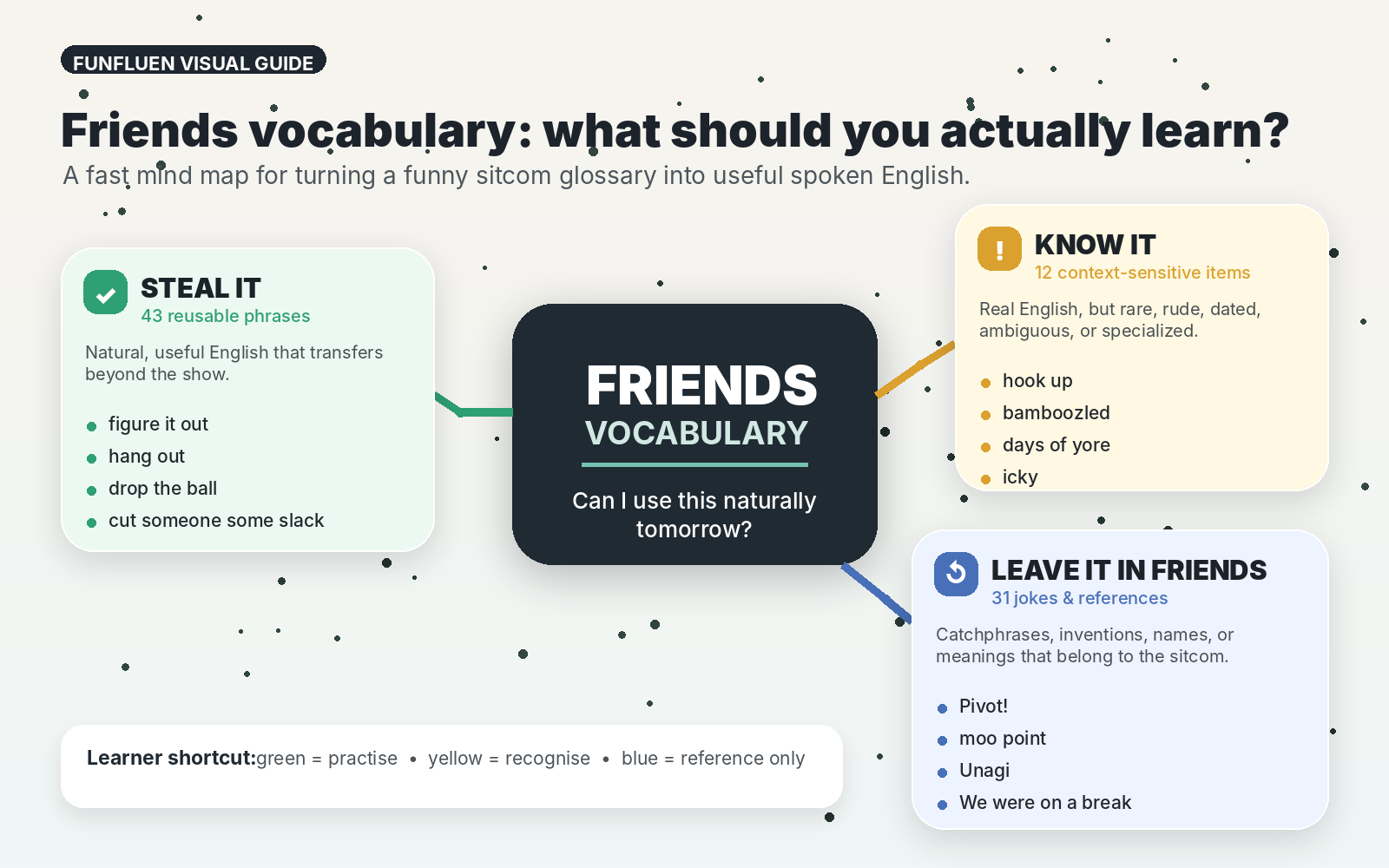
The 10-second Friends vocabulary test
| Term | Verdict | Why |
|---|---|---|
| Figure it out | 🟢 Steal it | Extremely common everyday English for solving or understanding something. |
| Cut it out | 🟢 Steal it | Useful casual English for “stop doing that,” though the tone is direct. |
| Hook up | 🟡 Know it | Real and common, but the meaning can range from connecting to a sexual or romantic encounter. |
| Days of yore | 🟡 Know it | Real English, but intentionally old-fashioned. |
| Moo point | 🔵 Leave it in Friends | The standard English phrase is moot point. |
| Pivot! | 🔵 Leave the catchphrase in Friends | Pivot is a real verb; Ross's repeated sofa command is the fandom reference. |
Teacher rule: an expression can be hilarious and still be a terrible vocabulary target. This page rewards transferability: can you move the phrase into your own work, friendships, dating, problems, plans and reactions without sounding like you are quoting television?
Quick Friends vocabulary lookup
🟢 43 phrases worth stealing
- A big break
- A judgment call
- All things considered
- Be on the table
- Be out of someone's league
- Cushion the blow
- Figure something out
- Gang up on someone
- Have a thing for someone
- Let it go
- Make it on your own
- More or less
- Not worth it
- Roll with the punches
- Something burns you up
- Take your mind off something
- The bottom line is ...
- Well up
- Ask someone out
- Go out with someone
- Go through something
- Get through something
- Get out of there
- Go on
- End up
- Hang out
- Come on
- Break up
- Move on
- Suck it up
- Cut it out
- Get real
- Run out on someone
- Be hung up on someone
- Sell someone out
- Be sick and tired of
- Quit cold turkey
- Get over it
- Hold someone over
- Cut someone some slack
- Ruffle some feathers
- Drop the ball
- Come back with something
🟡 12 real-English items to know
- Bamboozled
- Days of yore
- Nubbin
- Gleba
- Over my dead body
- Dead meat
- Hook up
- Smart-ass remark
- Dork
- Icky
- A watched pot never boils
- Brown-nosing suck-up
🔵 31 Friends references, jokes and catchphrases
- 15 Yemen Road, Yemen
- Central Perk
- Could I BE any more ...?
- Crap Bag
- Dr. Drake Ramoray
- The Geller Cup
- Holiday Armadillo
- How you doin'?
- Hugsy
- Ichiban, lipstick for men
- Joey doesn't share food
- Ken Adams
- Lobster
- Miss Chanandler Bong
- Moist Maker
- Moo point
- Oh. My. God.
- Pivot!
- Princess Consuela Banana Hammock
- The Rachel
- Regina Phalange
- Rosita
- The Routine
- Seven!
- Smelly Cat
- The trifle
- Transponster
- Unagi
- We were on a break
- Identical hand twin
- Crapweasel
43 useful Friends phrases you can actually use
These are the highest-value part of the glossary. Learn them as chunks—whole speaking tools—not as isolated dictionary words. The listening column shows words that often carry the strongest meaning stress. It is a practical cue, not a claim that every actor stresses the phrase exactly the same way in every scene.
| Phrase | Meaning | Tone / where it works | Listen for | New real-life example |
|---|---|---|---|---|
| A big break | an important opportunity that can change a career | neutral; common in careers | BIG break | A small festival booking became her big break. |
| A judgment call | a decision based on judgment when no rule gives a clear answer | neutral; useful at work and in life | JUDGment call | Cancelling the trip was a judgment call. |
| All things considered | after weighing the important positives and negatives | neutral; slightly polished | ALL things conSIDered | All things considered, moving was the right choice. |
| Be on the table | still be available for discussion or choice | neutral; especially useful at work | ON the table | A later launch date is still on the table. |
| Be out of someone's league | seem too attractive, accomplished, or high-status for someone | casual; often self-deprecating | OUT of your LEAGUE | He thought she was out of his league. |
| Cushion the blow | make bad news or rejection feel less painful | neutral-to-informal | CUSHion the BLOW | She called first to cushion the blow. |
| Figure something out | understand something or solve a problem | very common | FIGure it OUT | We'll figure it out after lunch. |
| Gang up on someone | join with other people against one person | negative; use carefully | GANG up on | Don't all gang up on him at once. |
| Have a thing for someone | feel romantic attraction, often without saying it directly | casual; personal | THING for | I think Maya has a thing for him. |
| Let it go | stop dwelling on, pursuing, or arguing about something | very common; tone can be supportive or dismissive | LET it GO | I fixed the mistake, so I'm letting it go. |
| Make it on your own | support yourself or succeed without depending heavily on others | neutral; encouraging | MAKE it on your OWN | She wanted to prove she could make it on her own. |
| More or less | approximately, mostly, or generally true | very common | MORE or LESS | The apartment is more or less ready. |
| Not worth it | not valuable enough to justify the cost, effort, time, or risk | very common; direct | WORTH it | The argument isn't worth it. |
| Roll with the punches | adapt when setbacks or changes cannot be avoided | informal; encouraging | ROLL with the PUNCHes | The plan changed twice, so we rolled with the punches. |
| Something burns you up | something makes you very angry or irritated | informal; a little old-fashioned for some speakers | BURNS you UP | It burns me up when fees appear at checkout. |
| Take your mind off something | distract yourself from a worry or painful thought | very common; supportive | MIND off | A walk might take your mind off the interview. |
| The bottom line is ... | introduce the most important conclusion or practical result | neutral; can sound blunt | BOTTOM LINE | The bottom line is, we need more testing. |
| Well up | for tears or strong emotion to rise and become visible | common in description; less conversational | WELLED up | Her eyes welled up when she saw the letter. |
| Ask someone out S1E1 | invite someone on a romantic date | casual; very useful | ASK you OUT | He finally asked her out for coffee. |
| Go out with someone S1E1 | date someone | casual; very common | GOING OUT with | Are you still going out with Alex? |
| Go through something S1E1 | experience a difficult or demanding period | very common; supportive | GO THROUGH | I don't want you to go through that alone. |
| Get through something S1E1 | survive, manage, or finish a difficult period | very common | GET THROUGH | How did you get through exam week? |
| Get out of there S1E1 | leave a place or situation, often quickly | casual; often urgent | GET OUT of THERE | The party felt weird, so I got out of there. |
| Go on S1E1 | continue speaking; tell me more | very common listener reaction | GO ON | Go on—what happened next? |
| End up S1E1 | reach a final result, often unexpectedly | extremely useful | END up | We ended up staying until midnight. |
| Hang out S1E1 | spend time casually with someone or somewhere | extremely common; casual | HANG OUT | We're just hanging out at home tonight. |
| Come on S1E1 | express disbelief, encouragement, impatience, or a push to act | extremely common; meaning depends on tone | COME on | Come on, you know that's not what I meant. |
| Break up S2E4 | end a romantic relationship | extremely common; neutral-to-casual | BREAK UP | They broke up last year but stayed friendly. |
| Move on S2E4 | continue with life after a relationship, disappointment, or past event | extremely common; supportive or blunt depending on tone | MOVE ON | It took her a while to move on after the breakup. |
| Suck it up S2E24 | accept something unpleasant and continue without complaining | casual; can sound harsh | SUCK it UP | I hated the early flight, but I sucked it up and went. |
| Cut it out S2E24 | stop doing something annoying or inappropriate | casual; direct | CUT it OUT | Cut it out—you're making me laugh. |
| Get real S2E24 | be realistic; stop pretending or being unreasonable | casual; often confrontational | GET REAL | Get real—we can't finish all of that tonight. |
| Run out on someone S2E24 | abandon a person or responsibility suddenly | negative; relationship-heavy | RUN OUT on | He ran out on the family when things got difficult. |
| Be hung up on someone S2E24 | remain emotionally fixated on a person, often an ex | casual; relationship language | HUNG UP on | She's still hung up on her ex. |
| Sell someone out S3E3 | betray someone by revealing information or choosing your own advantage | informal; negative | SELL me OUT | I told you that in confidence—don't sell me out. |
| Be sick and tired of S3E3 | be extremely annoyed or fed up with something | very common; emphatic | SICK and TIRED | I'm sick and tired of hearing the same excuse. |
| Quit cold turkey S3E3 | stop a habit suddenly and completely | common; often about habits or substances | COLD TURkey | He quit social media cold turkey for a month. |
| Get over it S3E3 | stop being upset about something | common but often blunt | GET OVER it | I was annoyed for a day, then I got over it. |
| Hold someone over S2E23 | provide enough temporary support until something more substantial arrives | useful but context-specific | HOLD you OVer | Have a snack to hold you over until dinner. |
| Cut someone some slack S2E23 | be less critical or demanding | excellent casual English | CUT me some SLACK | Cut her some slack—it's her first week. |
| Ruffle some feathers S2E23 | annoy or upset people, often by challenging expectations | neutral-to-informal | RUFFle some FEAthers | The new policy ruffled some feathers. |
| Drop the ball S2E23 | make a mistake or fail to do something you were responsible for | very common at work and in life | DROP the BALL | I dropped the ball and forgot to confirm the booking. |
| Come back with something S2E23 | respond with an answer, joke, argument, or remark | common; neutral-to-informal | COME BACK with | She came back with a better idea. |
About episode labels: this master glossary only shows an episode label where the phrase is supported by an existing episode vocabulary lesson. If a phrase is marked only as series-wide, the glossary does not guess a season or episode just to look more precise.
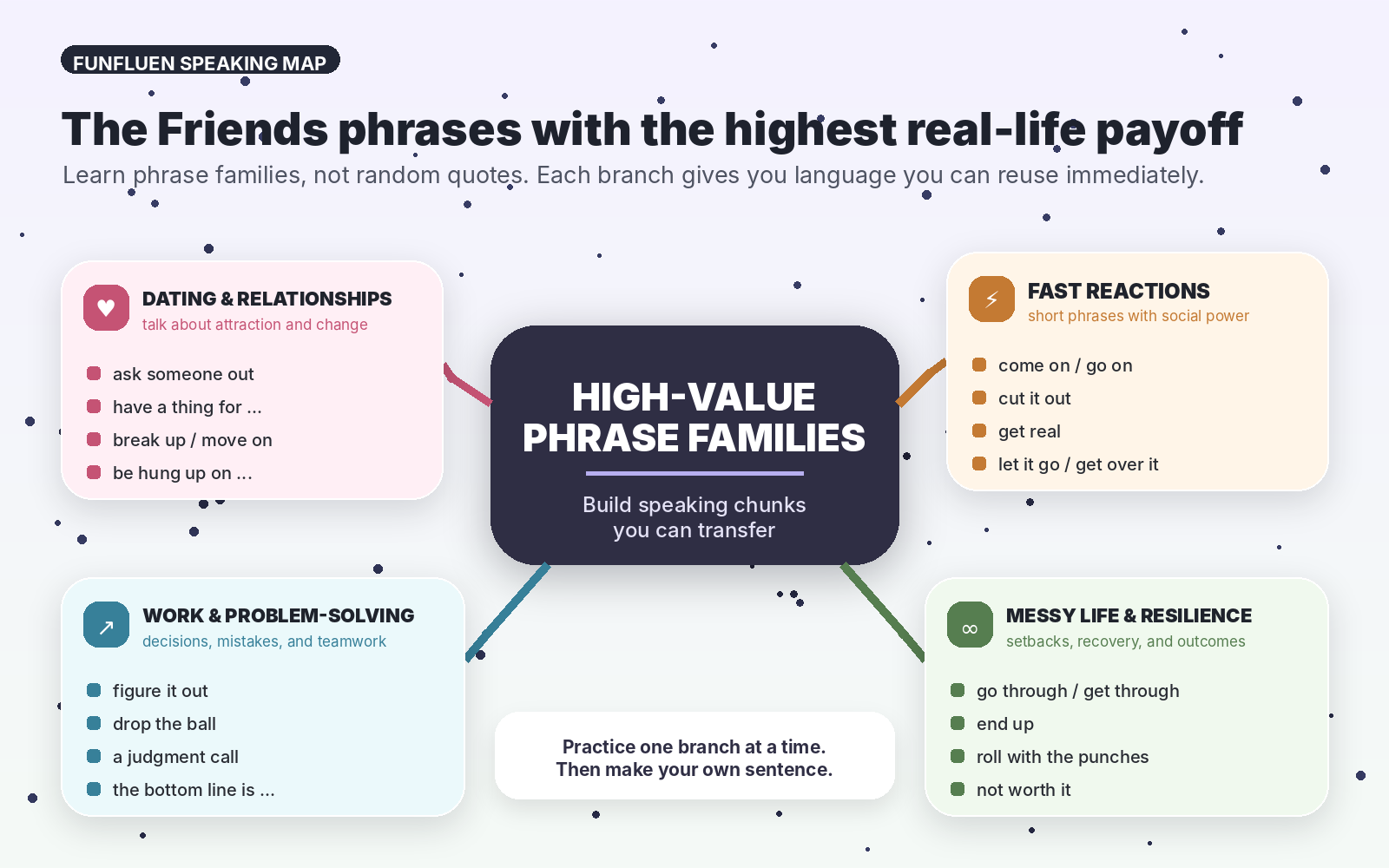
The most valuable phrase families in Friends
Dating and relationships
Prioritize ask someone out, go out with someone, have a thing for someone, be hung up on someone, run out on someone, be out of someone's league, break up and move on. They describe attraction, dating, attachment and relationship change far better than memorizing one-off romantic jokes.
Reactions that make spoken English faster
Come on, go on, let it go, cut it out, get real and get over it are short but socially powerful. The same words can sound playful, supportive, impatient or rude depending on stress, relationship and timing.
Problem-solving and work English
Figure it out, drop the ball, a judgment call, be on the table, the bottom line is, cut someone some slack and cushion the blow transfer easily into work, study and daily planning.
Getting through messy life
Go through something, get through something, end up, roll with the punches, take your mind off something, make it on your own and not worth it help you tell stories about setbacks, decisions and recovery.
Listen for the phrase, not the dictionary words
Friends is fast because speakers do not pronounce every word like a vocabulary recording. Treat the phrase as one rhythm unit:
- figure it out → keep figure-it-out moving as one chunk; do not pause after figure.
- have a thing for → the important word is usually thing; the small grammar words are lighter.
- cut me some slack → cut and slack carry the message; me some is lighter.
- get through it → hear get-through-it as a unit instead of three isolated words.
- out of your league → the contrast often lands on out and league.
- come on → meaning lives in the melody: disbelief, encouragement and impatience can use the same two words.
The useful question is not only “What does this phrase mean?” but also “What did it sound like when the speaker used it socially?”
12 Friends words and phrases to know—but not copy automatically
These are real English, but they need a warning label. Some are rare. Some are rude. Some are ambiguous. Some are mainly useful for recognition.
| Term | Meaning | Why it needs caution | Best learner action |
|---|---|---|---|
| Bamboozled | tricked or thoroughly confused | Real, colorful English. Capitalized Bamboozled is Joey's fictional game-show title; lowercase bamboozled is a real word. | Know it; use it when playful or emphatic. |
| Days of yore | a distant or romanticized time in the past | Real but deliberately old-fashioned/literary English; Friends uses that old-time flavor for comedy. | Recognize it; occasional humorous use. |
| Nubbin | a small bump, stub, projection, or partly developed feature | A real informal word, but rare and potentially insensitive when used about someone's body. | Mostly recognition. |
| Gleba | the spore-bearing inner tissue of certain fungi | A legitimate scientific word from mycology; its Friends baby-word joke is highly specific. | Scientific recognition only for most learners. |
| Over my dead body | a very strong refusal to allow something | Common idiom, but dramatic and confrontational even when joking. | Understand it before you copy it. |
| Dead meat | someone who is in serious trouble | Informal threat language; often playful among close friends, but it can sound aggressive. | Use only where playful intent is obvious. |
| Hook up | connect, meet, or have a sexual/romantic encounter depending on context | The modern meaning is ambiguous and can be sexual. Do not assume it simply means meet. | Learn the context before using it. |
| Smart-ass remark | a sarcastic, cheeky, or disrespectfully clever comment | Useful to understand, but ass makes it rude/informal. | Recognition or close-friends use. |
| Dork | a socially awkward, silly, or uncool person | Usually mild, but still labels a person and can insult. | Safer self-deprecating or among close friends. |
| Icky | disgusting, unpleasant, or emotionally uncomfortable | Real informal English with a childlike/playful flavor. | Fine casually; too childish for some settings. |
| A watched pot never boils | waiting impatiently makes time feel slower | A real proverb; understandable, but less common in spontaneous speech than simpler advice. | Know it; use occasionally. |
| Brown-nosing suck-up | a person who flatters someone powerful to gain favor | Very insulting and informal; brown-nosing and suck-up both carry contempt. | Recognize it; avoid at work unless describing language itself. |
31 Friends references, jokes and invented terms explained
These are the candy. They make the glossary fun, help you follow memes and fan conversations, and explain jokes that confuse learners. But they are not automatically good active vocabulary.
🔵 Leave it in Friends
15 Yemen Road, Yemen
What it means in Friends: The fake address Chandler gives while pretending work is sending him to Yemen.
Use it? A Friends-only address joke; do not treat it as a real mailing address.
🔵 Leave it in Friends
Central Perk
What it means in Friends: The fictional Manhattan coffeehouse where the group regularly meets.
Use it? A proper place name and fandom reference, not general coffee vocabulary.
🔵 Leave it in Friends
Could I BE any more ...?
What it means in Friends: A Chandler-style stress pattern where one word gets exaggerated prominence for sarcasm.
Use it? The grammar is normal; the delivery makes it an imitation and can sound mocking.
🔵 Leave it in Friends
Crap Bag
What it means in Friends: Mike's intentionally awful counter-name after Phoebe chooses an impractical new legal name.
Use it? Recognition-only. Crap is mild profanity.
🔵 Leave it in Friends
Dr. Drake Ramoray
What it means in Friends: The fictional neurosurgeon Joey plays on Days of Our Lives.
Use it? Character reference, not medical vocabulary.
🔵 Leave it in Friends
The Geller Cup
What it means in Friends: The homemade trophy tied to Ross and Monica's intensely competitive Thanksgiving football tradition.
Use it? A fan reference for comic sibling competition.
🔵 Leave it in Friends
Holiday Armadillo
What it means in Friends: Ross's improvised holiday character for teaching Ben about Hanukkah when a Santa costume is unavailable.
Use it? A Friends invention, not a figure from Jewish tradition.
🔵 Leave it in Friends
How you doin'?
What it means in Friends: Joey's signature flirtatious delivery of an ordinary greeting.
Use it? How are you doing? is normal; Joey's slow delivery turns it into a pickup line and obvious reference.
🔵 Leave it in Friends
Hugsy
What it means in Friends: Joey's much-loved stuffed penguin.
Use it? A proper name and character-detail reference.
🔵 Leave it in Friends
Ichiban, lipstick for men
What it means in Friends: The product name and slogan from Joey's over-the-top Japanese commercial.
Use it? Ichiban can mean 'number one/best' in Japanese; the full phrase is the Friends reference.
🔵 Leave it in Friends
Ken Adams
What it means in Friends: One of Joey's fake names, tied to the backpacking-story mix-up.
Use it? An ordinary-sounding personal name with show-specific meaning.
🔵 Leave it in Friends
Lobster
What it means in Friends: Phoebe's metaphor for two people who are destined to be together.
Use it? Fans may call a partner 'my lobster'; treat that as Friends-coded romance, not biology.
🔵 Leave it in Friends
Miss Chanandler Bong
What it means in Friends: The mangled name printed on Chandler's TV Guide and later used in the apartment trivia game.
Use it? Proper-name joke; chanandler is not an English word.
🔵 Leave it in Friends
Moist Maker
What it means in Friends: The gravy-soaked slice of bread in Ross's prized Thanksgiving leftover sandwich.
Use it? Show-specific food nickname that fans sometimes borrow.
🔵 Leave it in Friends
Moo point
What it means in Friends: Joey's mistaken version of moot point, built around the idea that a cow's opinion does not matter.
Use it? Do not learn moo point as standard English. The correct phrase is moot point.
🔵 Leave it in Friends
Oh. My. God.
What it means in Friends: Janice's signature exclamation, recognizable because of its stretched, dramatic delivery.
Use it? The words are ordinary English; the rhythm and imitation create the Friends reference.
🔵 Leave it in Friends
Pivot!
What it means in Friends: Ross's repeated moving instruction during the failed attempt to carry a sofa up a staircase.
Use it? Pivot is a real verb meaning turn around a fixed point; shouting it at furniture is the reference.
🔵 Leave it in Friends
Princess Consuela Banana Hammock
What it means in Friends: The absurd legal name Phoebe chooses after learning she can change her name to almost anything.
Use it? Recognition-only; banana hammock can be mildly suggestive slang.
🔵 Leave it in Friends
The Rachel
What it means in Friends: The layered haircut strongly associated with Rachel Green and 1990s fashion.
Use it? A proper hairstyle/Friends reference, not a general name for every Rachel haircut.
🔵 Leave it in Friends
Regina Phalange
What it means in Friends: Phoebe's recurring fake name for improvised identities and schemes.
Use it? A fictional personal name; phalange is also an anatomical term for a finger/toe bone.
🔵 Leave it in Friends
Rosita
What it means in Friends: The name Joey gives his favorite recliner.
Use it? A proper-name joke about his attachment to furniture.
🔵 Leave it in Friends
The Routine
What it means in Friends: Ross and Monica's choreographed sibling dance from their school years.
Use it? Capitalization points to the specific Friends dance; routine alone is ordinary English.
🔵 Leave it in Friends
Seven!
What it means in Friends: The number Monica emphasizes during an adult lesson about erogenous zones.
Use it? Adult sexual reference; unsuitable for many classrooms, workplaces, and family settings.
🔵 Leave it in Friends
Smelly Cat
What it means in Friends: The title of Phoebe's signature comic song.
Use it? Fan reference; this glossary does not reproduce the lyrics.
🔵 Leave it in Friends
The trifle
What it means in Friends: Rachel's disastrous Thanksgiving dessert made after two cookbook pages stick together.
Use it? Trifle is a real British dessert; the bizarre mixed version is the Friends joke.
🔵 Leave it in Friends
Transponster
What it means in Friends: Rachel's invented guess for Chandler's job during the apartment trivia game.
Use it? Not a real occupation or standard English word.
🔵 Leave it in Friends
Unagi
What it means in Friends: Ross's incorrect label for a state of total awareness and readiness.
Use it? In Japanese, unagi means freshwater eel. Ross's martial-arts definition is the joke.
🔵 Leave it in Friends
We were on a break
What it means in Friends: Ross's recurring defense in the long-running argument about his split from Rachel.
Use it? A fandom debate cue; in a real conflict it can sound dismissive rather than clarifying.
🔵 Leave it in Friends
Identical hand twin
What it means in Friends: Joey's name for a stranger whose hand appears remarkably similar to his own.
Use it? A plot joke, not a standard phrase for lookalikes or relatives.
🔵 Leave it in Friends
Crapweasel
What it means in Friends: A comic insulting compound used as a nickname.
Use it? Crap is mild profanity and weasel can suggest an untrustworthy person; best recognized rather than copied.
A short S1E1 starter: turn the pilot into real English
The pilot is a particularly good place to start because its coffeehouse and relationship scenes are packed with short conversational chunks. High-value targets include ask someone out, go out with someone, go through something, get through something, get out of there, go on, end up, hang out and come on.
For episode-level detail, use the Friends S1E1 vocabulary and everyday-reactions lesson and the Friends S1E1 phrasal-verbs lesson. For the wider study method, use Learn English with Friends.
Steal It or Leave It? Mini practice
Decide what you would do with each item before opening the answers:
- Cut me some slack. Use it, recognize it cautiously, or leave it in Friends?
- Transponster. Real job, rare word, or invented joke?
- I'm still hung up on her. Useful relationship English or sitcom-only?
- Days of yore. Normal daily phrase or real-but-old-fashioned English?
- Moo point. Standard phrase or joke based on another phrase?
- I dropped the ball. Can it work outside sports?
Show answers
- 🟢 Steal it. Natural casual English meaning “be less hard on me.”
- 🔵 Leave it in Friends. It is invented.
- 🟢 Steal it. Natural informal relationship English.
- 🟡 Know it. Real, humorous or literary, and old-fashioned.
- 🔵 Leave it in Friends. Learn moot point for standard English.
- 🟢 Steal it. It commonly means “I made a mistake or failed to handle my responsibility.”
Turn one Friends phrase into active vocabulary
Do not finish this page with 86 expressions sitting passively in your head. Pick one green phrase and run this four-step transfer:
- Hear it: replay a short scene and listen before reading the subtitle.
- Guess it: pause before the phrase and predict the missing reaction or chunk.
- Change it: make a sentence about your own life, not the character's life.
- Say it tomorrow: recall the phrase without looking before you save something new.
Example with drop the ball: “I dropped the ball and forgot to book the hotel.” Then change the person, tense or situation: “We can't drop the ball on the launch.” The phrase is now doing work for you.
Friends vocabulary FAQ
Is Friends good for learning English vocabulary?
Yes—especially for B1, B2 and early C1 learners—because the show repeatedly uses relationship talk, reactions, work problems, teasing, phrasal verbs and casual American English. It is less useful if you passively collect every unknown word without checking tone or reusing the phrase yourself.
What are the most useful Friends phrases to learn first?
Start with high-transfer phrases such as figure it out, hang out, ask someone out, go through something, get through something, cut it out, cut someone some slack, drop the ball, have a thing for someone and take your mind off something.
What is the difference between “Steal it,” “Know it,” and “Leave it in Friends”?
Steal it means the expression transfers naturally into real life. Know it means it is real English but needs caution because it is rare, rude, dated, specialized or ambiguous. Leave it in Friends means the special meaning belongs mainly to the show, its characters or its running jokes.
Is “moo point” correct English?
No. The standard expression is moot point. Moo point is Joey's joke based on the idea that a cow's opinion does not matter.
Does “unagi” mean total awareness?
No. In Japanese, unagi means freshwater eel. Ross's “state of awareness” explanation is the joke.
Can I say “How you doin'?” in real life?
Yes, as a reduced casual version of “How are you doing?” But Joey's slow, confident delivery turns it into a flirtatious pickup line and recognizable Friends imitation. The words are reusable; the performance changes the social meaning.
Should I memorize full Friends dialogue?
No. Memorize short, reusable chunks and the social job they perform. Long dialogue is harder to retrieve and often depends too heavily on plot, character relationships or joke setup.
Why does this glossary avoid reproducing long dialogue?
A language-learning glossary does not need to rebuild the script. Short identifiers, meanings, tone labels, listening cues and learner-made examples teach more transferable English while leaving the original performance where it belongs.
Keep learning with Friends
Use Learn English with Friends for the full scene-to-conversation method, then move into episode lessons when you want exact listening context. The master glossary is your vocabulary map; the episode pages are where sound, timing and situation become clear.
Explore more language-learning guides in Media-Based Language Learning.