 FunFluen
The Listening Ladder: A Step-by-Step Practice Method
Improve English listening with a 12-week ladder. Control six difficulty levers, know when to advance or drop back, and build skill step by step.

Build listening difficulty in controlled rungs: keep most conditions stable, change one variable, and advance only after you can repeat the target listening outcome without adding extra support.
Yesterday you understood an English clip. Today you picked a faster scene, removed captions, switched to an unfamiliar topic, added three speakers—and understood approximately the emotional atmosphere. That does not prove your listening got worse. It proves you changed too many things at once.
A useful listening ladder does the opposite: name the difficulty lever, move one lever, meet a clear gate, then earn the next rung.
The Six Variables You Can Stage
“Listen to harder English” sounds sensible until you ask the annoying but useful question: harder how? Harder is a mood, not a training metric.
Research on second-language listening supports the bigger idea behind this method: task difficulty is affected by multiple characteristics rather than one magical “level.” Studies have linked listening performance with factors such as lexical complexity, topic familiarity, speech-rate pressure, and the way text support is provided. That does not give us a universal formula for difficulty. It gives us something more practical: several levers we can manipulate deliberately.
- Topic familiarity
- A familiar topic gives you more context for predicting meaning. Later, you can move from a topic you know well to an adjacent topic and then to a genuinely new one. A 2026 study of 83 Chinese university learners found topic familiarity was positively associated with L2 English listening comprehension, although the study was correlational and does not prove a universal effect for every learner.
- Lexical and linguistic load
- Two clips at the same speed can feel completely different if one uses ordinary conversational vocabulary and the other packs in less familiar words, denser phrasing, or more complex relationships between ideas. Vocabulary knowledge has been strongly associated with advanced EFL listening performance, but there is no honest universal “known-word percentage” that this ladder can prescribe for every kind of audio.
- Playback or speech rate
- Rate changes processing pressure. Experimental work with time-compressed English found different recall patterns and performance across native listeners and EFL learners. Treat playback speed as one adjustable training lever—not as a test of courage. Artificially changing playback rate is also not identical to listening to a naturally fast speaker.
- Text support
- Captions and transcripts change the task. They can help you connect sound to form, but they can also carry part of the comprehension load for you. A small EFL study comparing caption conditions found different listening outcomes across conditions. So captions are a support setting, not a moral test.
- Replay allowance
- Understanding after three listens is a different task from understanding after one. In an exploratory study of 48 learners of Spanish, participants understood additional information on later repetitions. That supports repetition as a plausible practice lever, but it does not give English learners a universal gain percentage or stopping rule.
- Task precision
- “What was the main idea?” is easier than “What four details were mentioned?” and very different from “Write this exact line.” You can make the same audio harder simply by demanding more precise listening. This is where dictation belongs later in the ladder.
You do not need to push all six upward. You need to know which one you are pushing now.
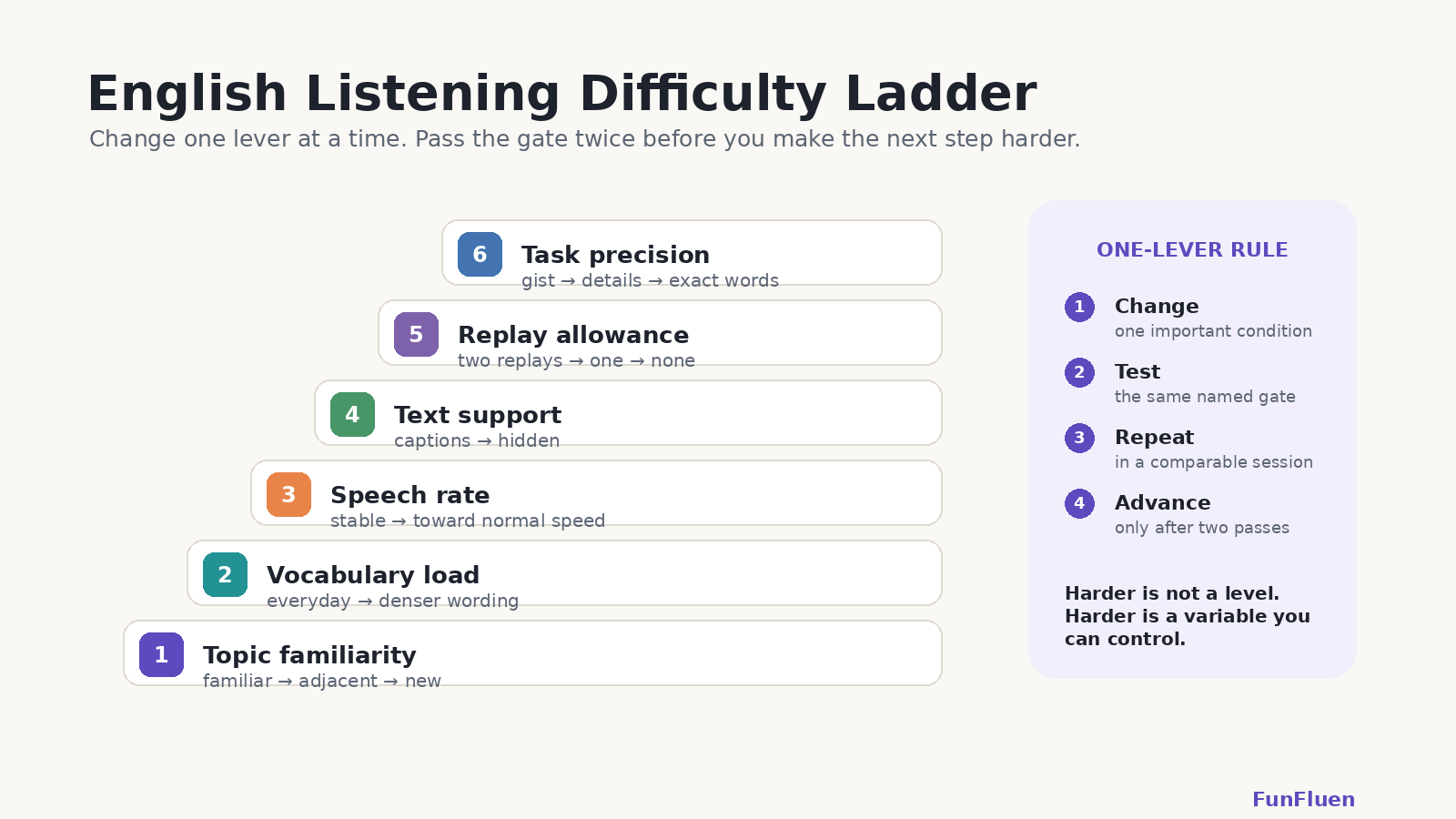
Change One at a Time
Suppose last week you understood a familiar interview at your current playback speed with target-language captions available. This week you remove captions, increase the speed, choose a new topic, and switch to denser dialogue. When comprehension collapses, what caused it?
You have no idea. You have created a listening ambush.
The one-variable rule is not a proven law of language acquisition. It is a diagnostic design principle: when the newest practice session differs from the last stable one in only one important way, a pass or failure tells you much more about what your ear is ready for.
Which lever moved?
Compare the session that felt unstable with your last stable session. Check every important change.
If you checked more than one changed lever
Return to the last stable setup. Reintroduce only one of those changes. Your difficult session may have been useful practice, but it was not a clean diagnosis.
If you checked exactly one changed lever
You have isolated a useful challenge. If you passed the gate twice, keep the new condition and advance. If the result was mixed, hold. If you failed twice under comparable conditions, remove that newest difficulty and confirm the previous rung before retrying a smaller step.
If you checked no changed lever
Do not invent a grand explanation from one bad session. Repeat under comparable conditions before changing the ladder. A single clip or a single day can be unusual; the point of the method is to avoid treating noise as a permanent level diagnosis.
Advance Criteria per Rung
“That felt easier” is encouraging. It is also a terrible gate.
A useful advance criterion has four parts:
- Condition: what support and difficulty settings are fixed?
- Task: what exactly must you do after listening?
- Observable outcome: what counts as success?
- Repeat rule: how will you check that the result was not a one-off?
For example: After no more than two listens with captions hidden, I can state the main point and two accurate details before checking the transcript, in two separate comparable sessions.
This article uses small “can-do” style gates because they are easier to act on than vague difficulty ratings. The Council of Europe also expresses CEFR performance through illustrative can-do descriptors, but do not confuse this ladder with CEFR placement: these gates are not official CEFR descriptors, and passing them does not prove that you gained a CEFR level.
To verify a detail gate, compare your answer with a reliable transcript, captions, answer key, or other trustworthy text after the scored listening pass. If you have no way to check whether your details were accurate, use that audio for enjoyment, not for a rung that depends on precise measurement.
When to Drop Back
Dropping back is not the sad trombone of language learning. It is the part that makes the ladder diagnostic.
Use this sequence:
- Fail once? Hold the rung. Do not immediately redesign your entire practice plan.
- Fail again under comparable conditions? Remove the newest difficulty.
- Repeat the previous stable setup and confirm that its gate still holds.
- Retry the difficult lever with a smaller change, or spend another cycle stabilizing the previous rung.
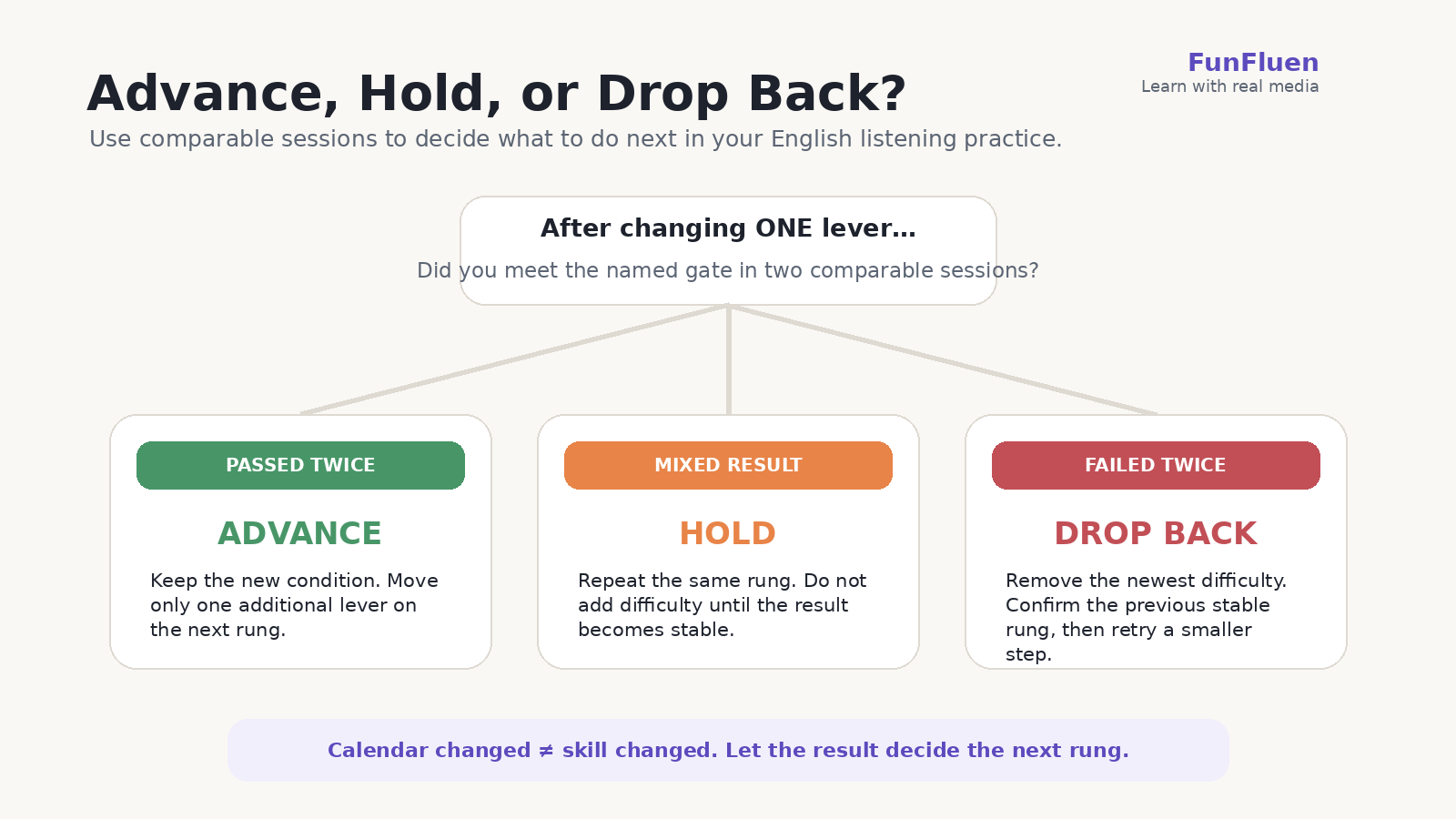
Example: removing captions broke the gate
If you were stable with target-language captions and then failed after hiding them, do not also slow the audio, choose easier vocabulary, and switch topics. Restore the previous text-support setting first. Once the previous rung is stable, try reducing caption support again in a smaller or more controlled way.
Example: increasing playback rate broke the gate
Return to the last stable rate while keeping topic, text support, replay allowance, and task unchanged. When the gate is stable again, move the rate by one smaller step toward normal source speed. There is no prize for making normal speech artificially faster than normal merely because a calendar says “Week 9.”
In the exploratory repeated-listening study of Spanish learners mentioned above, participants recovered additional information on later passes. That makes a hold week a reasonable place for deliberate repetition. It does not mean more repetitions always produce the same gain—or that more suffering automatically means more learning.
A Twelve-Week Ladder
Here is the complete plan. One warning before you tattoo “Week 12” onto your calendar: week means nominal rung, not deadline. If you do not meet a gate, repeat that rung. Your twelve-rung ladder may take fourteen weeks, eighteen weeks, or longer. That is not a bug.
Start with short English material whose topic and format are familiar enough that you can already get the gist. Choose a playback rate where the current task is stable. Do not copy somebody else’s starting speed because it looks more impressive in a screenshot.
For every rung below, keep the other five levers at the settings from your last passed rung. Unless a rung says otherwise, meet the named gate in two separate comparable sessions before advancing.
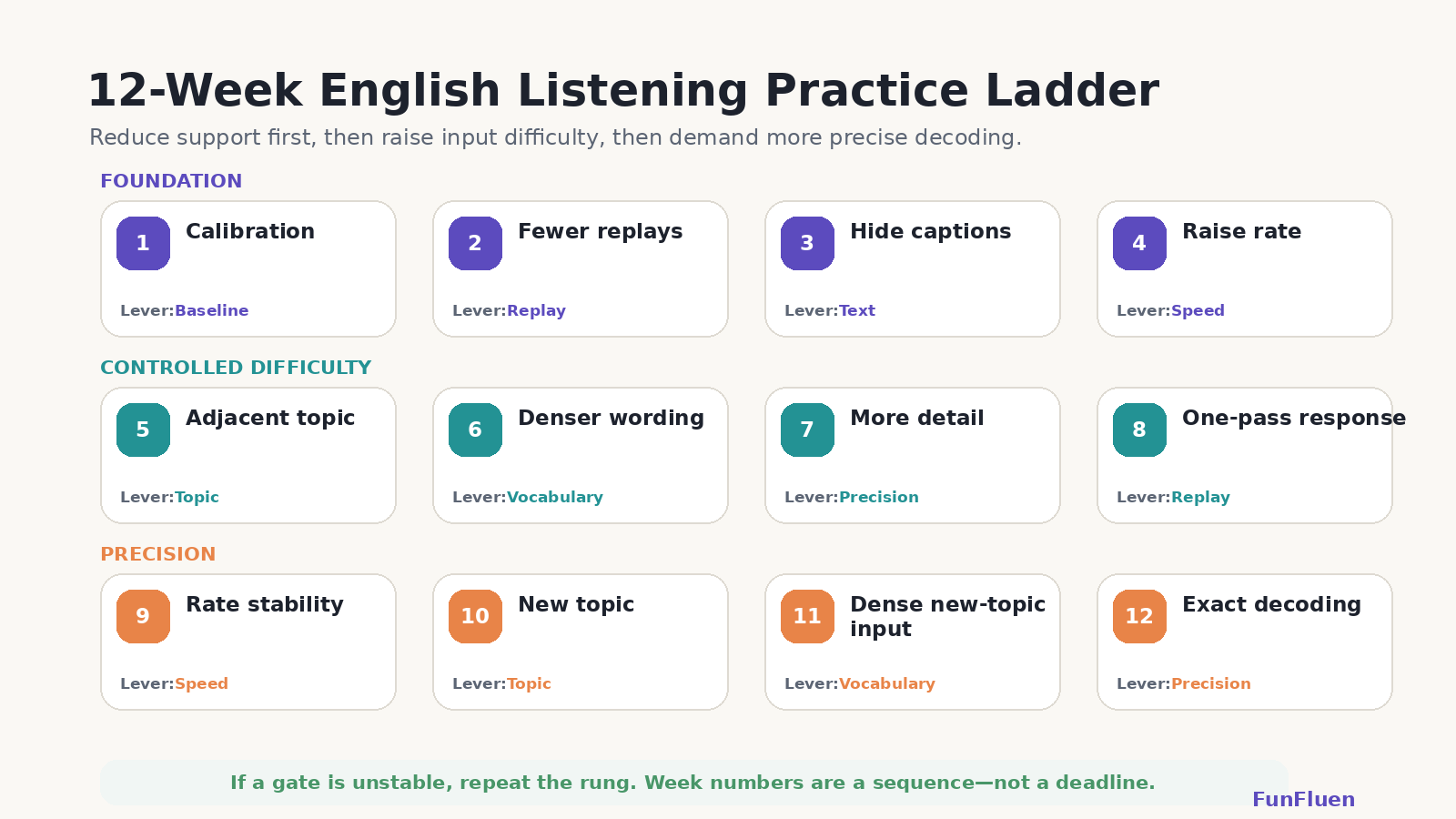
Week 1: Calibration
Lever changed: Baseline only; no difficulty increase yet.
New condition: Familiar topic, current stable speed, up to two replays. Target-language captions may be used on the final listen.
Stable-baseline gate: Before checking a transcript, state the main point and two accurate details on two different but comparable clips.
Week 2: Fewer Replays
Lever changed: Replay allowance.
New condition: Reduce from up to two replays to one replay.
Two-listen gate: After no more than two total listens, state the main point and two accurate details.
Week 3: Remove Live Text
Lever changed: Text support.
New condition: Hide captions during the scored listens. Check the transcript only after you answer.
No-live-text gate: Under the same listen allowance, state the main point and two accurate details without seeing text during listening.
Week 4: Raise the Rate
Lever changed: Playback rate.
New condition: Move one small step toward normal source speed. Keep topic, text support, replay allowance, and task unchanged.
Rate-step gate: Meet the Week 3 outcome at the new rate. If you already listen at normal source speed, use this as a consolidation rung rather than accelerating audio above normal just to make it “harder.”
Week 5: Adjacent Topic
Lever changed: Topic familiarity.
New condition: Move from a very familiar topic to an adjacent one while keeping the same general format, rate, support, and task.
Adjacent-topic gate: State the main point and two accurate details on two clips from the adjacent topic.
Week 6: Denser Wording
Lever changed: Lexical and linguistic load.
New condition: Within the same topic and format, use material that is somewhat denser or contains less familiar wording. Do not add a speed or topic jump.
Lexical-load gate: Preserve the main point and two accurate details even when transcript review afterward reveals several unfamiliar or hard-to-segment expressions.
Midpoint check: you are not trying to collect six weeks of suffering. By now you should have a stable baseline, less replay support, less live text, and at least one controlled increase in input difficulty. If one of those is still unstable, repeat it before moving on.
Week 7: More Detail
Lever changed: Task precision.
New condition: Keep the audio conditions stable, but ask for detailed recall instead of gist alone.
Detail gate: State the main point plus four accurate details, then verify them against the transcript.
Week 8: One-Pass Response
Lever changed: Replay allowance.
New condition: Answer after one full listen. Replays happen only after your scored response, for learning.
One-pass gate: After one listen, state the main point and at least two accurate details on two comparable clips.
Week 9: Rate Stability
Lever changed: Playback rate.
New condition: If you are still below normal, move one more small step toward normal. If you are already at normal source speed, hold it.
Normal-rate stability gate: Meet the Week 8 outcome twice at the highest natural/source rate you are currently training. Do not manufacture an above-normal speed target.
Week 10: New Topic
Lever changed: Topic familiarity.
New condition: Move from the now-familiar topic family to a genuinely new topic while keeping format, rate, text support, replay allowance, and task stable.
New-topic gate: After one listen, give the main point and two accurate details without text during the scored pass.
Week 11: Dense New-Topic Input
Lever changed: Lexical and linguistic load.
New condition: Within the new topic, choose a somewhat denser clip while holding the other levers constant.
Dense-input gate: Keep the gist and two accurate details even when later transcript review exposes multiple unfamiliar or difficult-to-segment expressions.
Week 12: Exact Decoding
Lever changed: Task precision.
New condition: Keep the Week 11 audio settings. First answer for gist after one full listen; then choose one short target segment for exact transcription.
Exact-decoding gate: Give the gist and two accurate details from the first full listen. Then, after no more than two targeted replays of the short segment, write every spoken word. Compare your version with a reliable transcript, ignoring punctuation and capitalization. If a spoken-word mismatch remains, identify what you misheard, classify the mismatch, replay the corrected form, and hold the rung rather than calling it a pass. Meet this gate in two separate comparable sessions before finishing the ladder.
The two targeted replays and exact-match rule are this method’s training constraints, not research-derived universal thresholds.
Outside a lab, you will not isolate lexical density with perfect precision. That is fine. The goal is not laboratory cosplay. The goal is to avoid obvious multi-variable jumps. If your “denser vocabulary” clip also turns out to be much faster, much less familiar, and full of overlapping voices, it is a poor diagnostic rung even if it is excellent entertainment.
Write Your Next Rung Before You Press Play
Current stable conditions: ______________________________
The one lever I will change: ______________________________
My named gate: ______________________________
What I will restore if the gate fails repeatedly: ______________________________
Combining with Dictation
Dictation is useful here because it changes task precision. It can expose a gap that gist listening politely hides: you understood the scene, but your ear did not map one reduced sound sequence to the right English form.
One older study of 60 male elementary EFL learners in Iran found stronger listening-comprehension gains for a group that received frequent dictation during a course than for the comparison group. That is interesting support for dictation as an adjunct, but it is a small, specific study—not proof that everybody should spend half an hour transcribing every episode.
Use a short dictation pass after you have already listened for meaning:
- Listen to the clip for gist under the current rung’s normal conditions.
- Choose one short line that still feels blurry.
- Write exactly what you think you heard.
- Replay that line a limited number of times without opening the transcript.
- Compare your version with a reliable transcript or captions.
- Classify the mismatch: sound boundary, grammar form, vocabulary, collocation, or register detail.
- Listen once more, then say the correct line aloud.
Three Useful Kinds of Dictation Mismatch
“I use to work there.”
- Classification
- Wrong in an affirmative sentence about a past habit.
- What a listener would understand
- A listener will probably understand the intended past habit, especially in speech, because used to is often reduced.
- Likely learner intent
- Past habitual employment.
- Natural alternative / source form
- “I used to work there.”
- Context note
- Use to can be natural after did: “Did you use to work there?” The error is not that the two words can never appear together; it is the affirmative past-habit form here.
“Can you send it by Friday?” when the audio said “Could you send it by Friday?”
- Classification
- Grammatically valid with a different meaning.
- What a listener would understand
- A normal request, usually a little more direct than the could version in this context.
- Likely learner intent
- To reproduce the softer request in the audio exactly.
- Natural alternative / source form
- “Could you send it by Friday?”
- Context note
- Both are common and natural. The requested action is essentially the same here; the important difference is interpersonal/register nuance. Could often makes the request sound softer or more tentative, while can can sound more direct. The can sentence is not universally wrong.
“I did a lot of progress.”
- Classification
- Unusual / overly formal / non-idiomatic—specifically, a non-idiomatic collocation.
- What a listener would understand
- The meaning is understandable, but the phrase sounds unnatural to many English speakers.
- Likely learner intent
- To say that improvement was substantial.
- Natural alternative / source form
- “I made a lot of progress.”
- Context note
- Make progress is the conventional collocation. English commonly uses do with expressions such as do homework or do the work, but not normally do progress.
These examples separate what you heard from what the sentence means. A dictation mismatch may reveal a sound-decoding problem even when your overall comprehension was fine.
Production Drill: Close the Loop
After you can hear the line clearly, say it once without reading: “I used to work there, but now I work from home.” Then replace the content while keeping the pattern: I used to live there… I used to study there… I used to go there every weekend.
The goal is not accent perfection. You are making the sound-form connection active enough that the next used to has a better chance of arriving as language rather than mysterious audio fog.
Common Sequencing Errors
If every week is Boss Level, the ladder is just a wall with optimism painted on it. Before your next session, check the mistakes that look suspiciously familiar.
Quick Sequencing Check
Fix: restore the last stable setup and keep only one new challenge.
Fix: choose the next diagnosable rung, not the most impressive failure.
Fix: treat text as adjustable support. Reduce it when the rung says to reduce it.
Fix: repeat comparable conditions first. One bad clip is not a court ruling on your English.
Fix: listen for meaning first; use short dictation later as a precision lever.
Fix: repeat the rung. The schedule serves the skill, not the other way around.
By this point, the ladder should feel less heroic and more boringly clear. That is good. A training method is allowed to be less dramatic than your favorite crime series.
Sources and Scope
The research below supports individual parts of the method. None of these sources validates this exact twelve-week order, the two-session rule, or a universal time-to-fluency claim. Those are deliberately presented as practical design choices.
- “TEXT CHARACTERISTICS OF TASK INPUT AND DIFFICULTY IN SECOND LANGUAGE LISTENING COMPREHENSION” — Révész and Brunfaut, Studies in Second Language Acquisition, 2013. Advanced ESL listening-task research showing that multiple text characteristics, including lexical measures, predicted task difficulty.
- “VOCABULARY KNOWLEDGE AND ADVANCED LISTENING COMPREHENSION IN ENGLISH AS A FOREIGN LANGUAGE” — Stæhr, 2009. Research with advanced Danish EFL learners linking vocabulary knowledge and listening performance; its study-specific lexical-coverage result is not used here as a universal threshold.
- “Exploring the contribution of topic familiarity and listening strategies to listening comprehension among L2 learners of English” — Huang and Wang, 2026. Correlational research with Chinese university learners; useful support for topic familiarity as a relevant factor, not proof of a universal causal rule.
- “The Effects of Time-Compressed Speech on Native and Efl Listening Comprehension” — Conrad, Studies in Second Language Acquisition, 1989. Experimental evidence that rate pressure changes the listening task; it does not prescribe one ideal playback speed.
- “Captions and reduced forms instruction: The impact on EFL students’ listening comprehension” — Yang and Chang, ReCALL, 2014 issue. A small university EFL intervention comparing caption conditions; it does not prove captions are always better or always worse.
- “Quantifying comprehension gains after repeated listening by students of Spanish with different listening ability: an exploratory study” — Rodrigo, 2017. Exploratory research with 48 learners of Spanish finding additional comprehension after repeated listening; exact gains are not generalized to English learners here.
- “The Effect of Frequent Dictation on the Listening Comprehension Ability of Elementary EFL Learners” — Kiany and Shiramiry, 2002. A small, specific EFL study supporting dictation as a possible adjunct, not a universal dosage.
- “The case for narrow listening” — Krashen, 1996. A proposal for repeated listening around learner-selected topics with gradual topic change; it is not controlled proof of this ladder’s schedule or gates.
- CEFR Descriptors — Council of Europe. Official can-do descriptor framework used here only as inspiration for observable criteria, not to map these rungs to CEFR levels.
Build the Next Rung, Not the Whole Staircase
The opening problem was never that one hard English clip defeated you. The problem was that you could not tell why it defeated you.
After a few weeks with a listening difficulty ladder, the question changes. Instead of “Why am I still bad at listening?” you can ask: “Which rung is stable? Which one lever am I changing next? What will count as a pass? What will I restore if it breaks?”
That is a much better question. It turns a wall of fast English into a sequence of visible decisions.
If you want the broader framework around learning from real shows, videos, and other media, continue with FunFluen’s guide to media-based language learning. But for your next session, keep the job smaller: write one rung, one gate, one rollback—and press play.